Article
Contrata Assessment Studio: design the evidence request before the questionnaire
Plan a service-specific question, bounded evidence request and section responsibilities before asking a supplier to complete an assessment.
Contrata editorial team ·

Product feature. “Do you delete our data?” looks like a simple supplier question. Before sending it, your team needs to decide which data, what deletion means for this service and what evidence would make the answer useful. Otherwise, a completed questionnaire can send the reviewer back to the beginning.
Contrata's maintained product reference places Assessment Studio under Control Centre as template administration. The recorded interface includes a template library, search and Create template. Its empty-state description covers choosing an assessment area and type, designing questions and evidence requirements, and section responsibilities.
Those observations give this feature a practical starting point: plan the assessment before collecting responses. They come from the October product reference, including a read-only interface inspection and a later frontend source review; this article is not a fresh runtime test. The fictional example below explains the planning task rather than reproducing a product screen.
Start with the service the template will assess
Imagine an organisation choosing a provider to print and dispatch customer letters. The organisation supplies an address file and the material to print. The provider prepares the print job, dispatches the letters and handles agreed exceptions. This service and all example records are fictional.
The initial template question reads: “Do you delete customer data after use?” A supplier could answer yes while referring only to the original upload. The reviewer might have meant working copies used to prepare the print run, files held for reprints or retained exception records.
Before polishing the wording, ask the internal service owner what the arrangement needs. Which files does the provider receive or create? What work remains after dispatch? Who can authorise a reprint? Which records does the buyer need back? Do not choose a retention period simply to fill a template field; agree the applicable requirements with the relevant owners.
For a broader question bank, use the third party risk assessment questionnaire. Select the questions that fit the service, then make the evidence request specific enough for someone to assess the response.
Design one question and its evidence requirement together
For the print-and-dispatch example, a more useful question is:
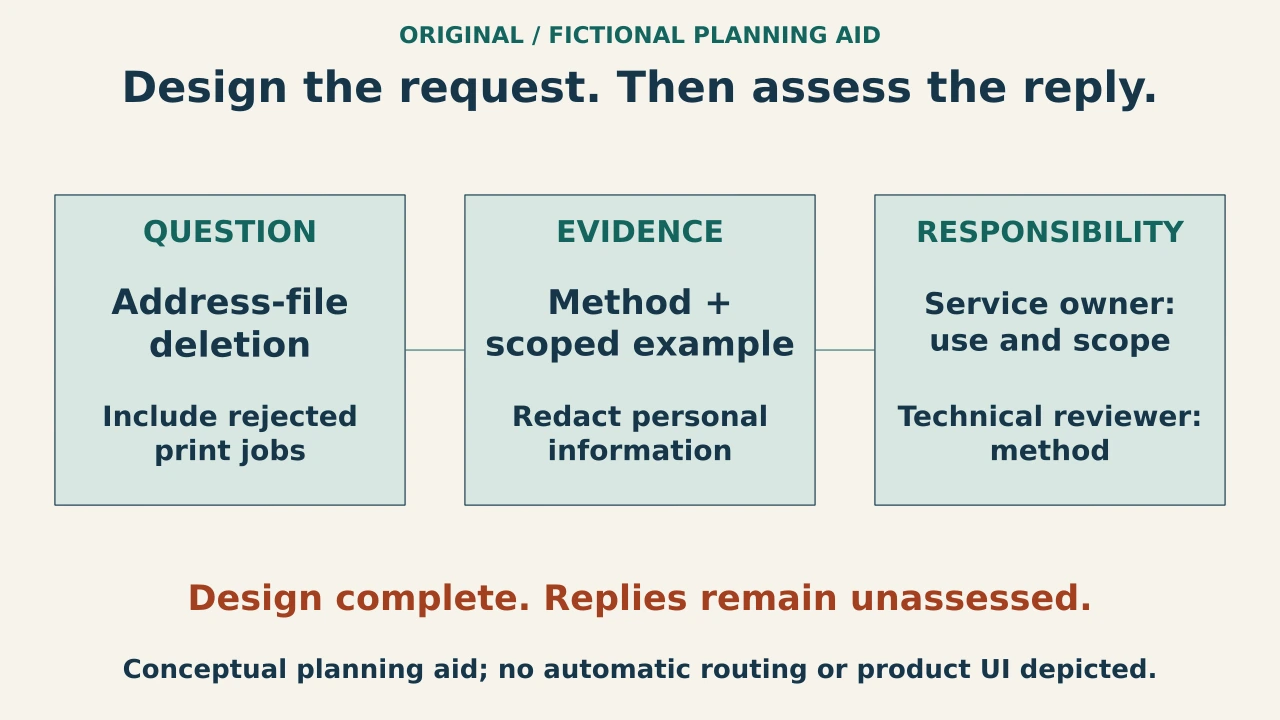
“For this service, how are the supplied address file and working copies retained and deleted after dispatch, including copies used for exceptions or reprints?”
That wording identifies the service and records. It leaves room for an honest explanation of different treatments rather than inviting an unqualified yes.
Write the evidence request beside the question:
“Describe the relevant file locations or processing stages, the event that starts each retention period, who authorises exceptions and what evidence of deletion can be inspected. Provide a redacted example for a completed print job, or explain the available alternative and its limits. Identify any copies outside the described deletion process.”
Request only the material needed for that review. An example can use synthetic identifiers and omit customer addresses. Agree an authorised sharing or inspection method if the evidence contains sensitive operational detail.
Give section responsibilities a concrete purpose
Section responsibilities are useful when they explain who will examine the answer. In a lean team, one person may coordinate the assessment while different colleagues contribute specific judgements.
| Suggested responsibility in this fictional assessment | Review to perform |
|---|---|
| Technical reviewer | Examine the described file locations, deletion mechanism, example evidence and exclusions. Record what the evidence establishes and what cannot be verified. |
| Service owner | Check whether reprint and exception handling fit the operational arrangement, and whether the proposed treatment meets the buyer's agreed needs. |
| Assessment coordinator | Keep the question, request and intended reviewers aligned before issuing the assessment; obtain specialist input where needed. |
These are suggested responsibilities for planning the example. The maintained reference supports section responsibilities as part of template design; it does not establish that Contrata automatically assigns these people, enforces required responses or controls who can approve a risk.
The technical reviewer should not have to guess whether the organisation still needs a file for an unresolved dispatch exception. The service owner should not have to infer how a deletion record relates to the processing system. Designing both reviews into the assessment exposes that hand-off early.
Check the template before using it for responses
Read the proposed question and evidence request as if you were the supplier. Could you identify the service, the records and the requested explanation? Then read them as the reviewer. Could a plausible response answer the question while leaving a significant copy or processing stage unexplained?
Have the two example reviewers challenge the draft together. If the request asks for proof the supplier cannot reasonably disclose, agree a suitable alternative and record its limits. If it mixes several unrelated decisions, separate the questions rather than making one paragraph longer.
Assessment Studio's template-administration role is distinct from the assessment response workspace. The maintained frontend reference describes the response workspace's questions, section navigator and evidence/context pane separately; external recipient pages are also separate. For the later response stage, see suggested, saved and reviewed assessment answers.
Before adopting a template, confirm its service fit, evidence wording and review responsibilities with your team. The planned request gives the supplier a clearer task. The returned material still needs examination, and the organisation retains its risk decisions. In a demonstration of Contrata's assessment capabilities, bring one suitably sanitised question and ask to work through that design task.