Article
Build a supplier-incident intake that supports timely escalation
Build a supplier-incident intake with clear timestamps, operational impact and decision owners. Distinguish APRA notification triggers before an outage.
Contrata editorial team ·
A provider reports a processing problem. Its message says the investigation is continuing, gives no restoration estimate and refers to a technical component your incident team does not recognise. Meanwhile, customers are calling about transactions that have not completed.
The first job is to establish what your organisation knows about its own service. Waiting for the supplier's final incident report leaves a gap between the event and the decisions your team needs to make.
This suggested intake approach helps a bank connect supplier information with operational escalation. It is an illustrative working method, not a replacement for its incident procedures, regulatory advice or notification obligations.
Give each timestamp a meaning
An incident record can contain several different times: when a service stopped, when the supplier detected the problem, when it told your organisation, when your organisation became aware of relevant impact, and when a tolerance was exceeded. Preserve those distinctions, including the time zone and the source of each fact.
Do not overwrite an early estimate when better information arrives. Keep the original entry and record the correction. That history helps a later reviewer understand what the decision-maker could reasonably see at each stage.
Assign someone to maintain the chronology while others manage recovery. Asking the incident commander to reconstruct every message after the event is a fragile arrangement, particularly when several suppliers are involved.
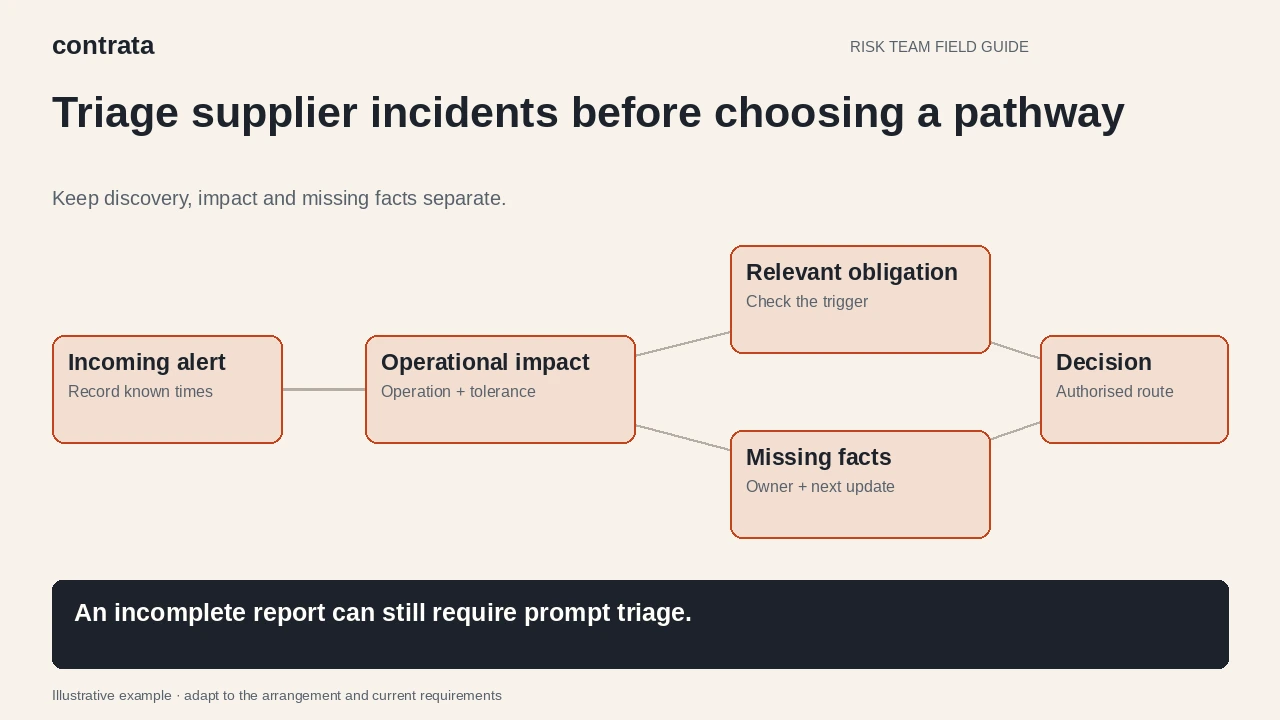
Ask for facts that change an action
A useful opening request to the supplier asks for:
- The affected service, environments and customer-facing functions.
- The earliest known disruption time and the confidence in that estimate.
- Current processing status, data integrity concerns and any transactions needing reconciliation.
- Actions already taken, proposed workarounds and their limitations.
- The next update time and a reachable incident contact.
Avoid turning the first exchange into a complete root-cause questionnaire. The immediate purpose is to support containment, service continuity and escalation. The root cause, full chronology and longer-term remediation can develop as evidence improves.
Internally, pair that supplier message with the operation it supports, the business owner, the relevant tolerance and the available fallback. A supplier saying its platform is available does not establish that your payment process has completed successfully.

Separate the notification triggers
Under CPS 230, notification is required as soon as possible and no later than 72 hours after awareness of an operational-risk incident determined likely to have a material financial impact or a material impact on maintaining critical operations. A separate requirement applies as soon as possible and no later than 24 hours after a disruption to a critical operation outside tolerance. The CPG 230 notification table says the shorter timeframe applies where notification categories overlap.
Those are different tests. Have the designated regulatory owner check the exact applicable conditions promptly; do not give every supplier incident a default 72-hour timer.
Information-security events also need the CPS 234 notification provisions checked. They include incidents notified to other regulators and a separate material-control-weakness requirement. CPS 230 addresses duplication for incidents reported under CPS 234, but that does not justify ignoring a shorter applicable timeframe or other obligations.
Your intake should identify the decision-maker, their deputy and the approved submission route. Capture the facts considered, the conclusion, its time and the next reassessment trigger. An internal escalation is not evidence that a regulator has been notified.
Work an incomplete report through the process
Consider a fictional bank whose supplier handles an overnight transaction file. The supplier reports that a batch is delayed and that its infrastructure is healthy. The bank's operations team finds that processing has stopped before reconciliation.
The incident coordinator records the supplier's statement as a statement, not a verified recovery conclusion. The operations owner identifies the affected payment activity and checks the bank's tolerance position. The technology owner tests whether the alternative processing route can be used without creating duplicate transactions.
At this point, the unknown restoration time remains visible. The regulatory owner assesses the notification triggers using the available facts and follows the bank's escalation procedure. The team does not wait for the supplier to label the event “material”. That label belongs to the supplier's own assessment and may address a different impact.
When the batch restarts, the bank records two separate observations: processing resumed, and reconciliation remains incomplete. The incident stays under the appropriate oversight until the relevant service outcome and remaining risks are understood.

Make the handover easy to inspect
A compact handover can answer seven questions:
- What service and operation are affected?
- What happened, and which facts are still uncertain?
- What are the relevant event, awareness and impact times?
- What is the current tolerance and customer-impact position?
- Who owns recovery, regulatory assessment and communications?
- What has been decided or submitted, with what evidence?
- What is the next action, update time and escalation trigger?
Store sensitive incident information in the approved restricted location. A broadly distributed status update usually needs less detail than the investigation record. Use links and access controls rather than copying operational or customer data into every email.
If the supplier report also raises a possible privacy breach, the data-breach response guide explains how to keep operational and privacy work connected without treating their notification tests as interchangeable.
After the incident, compare the first supplier notice with the questions the team actually needed answered. Improve the contact list, notice expectations and intake fields where those gaps delayed decisions. The evidence checklist offers a complementary way to connect the resulting findings with sources and accountable follow-up actions.