Article
Check an AI-assisted supplier assessment before approving it
A practical human review for AI-generated supplier assessment answers: check sources, scope, dates, contradictions and the authority to decide.
Contrata editorial team ·
An AI-generated assessment says a supplier's recovery arrangements are effective. It cites a test report and offers a confident explanation. Before approving the answer, the reviewer needs to check whether the report supports that conclusion for the service being assessed.
This is a review task with several parts: finding the source, checking its scope, comparing it with other evidence and deciding what the organisation is prepared to rely on. A fluent answer does not complete those steps by itself.
The method below is educational and tool-neutral. It does not describe a particular product or promise a level of AI accuracy. The example is fictional, and the suggested checks are an original editorial workflow.
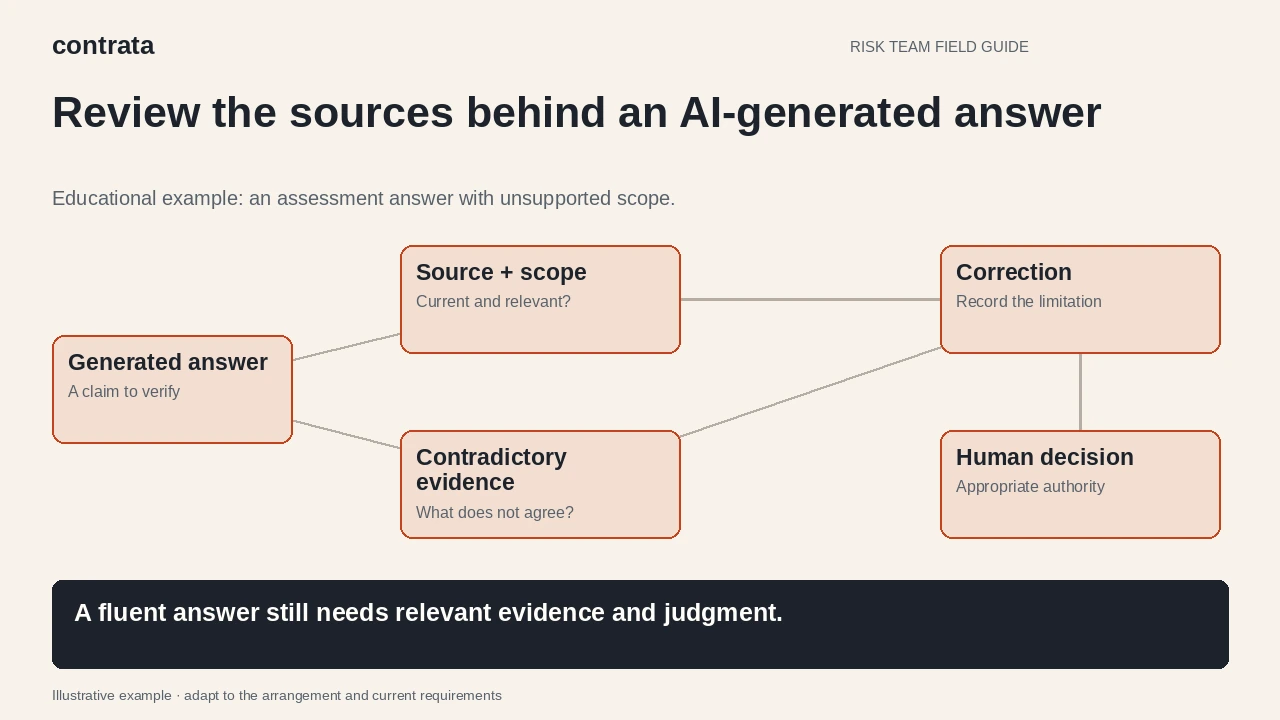
Keep the decision and the generated answer separate
An assessment answer might describe evidence, propose a conclusion or recommend a decision. Make those layers visible.
“Recovery was tested” is a factual claim about an event. “The test covered our service” is a scope claim. “The results are sufficient for approval” is a judgement under your organisation's criteria. A single paragraph can blend all three so smoothly that the reviewer misses the change in meaning.
APRA and ASIC's August 2026 roundtable insights discuss governance, reliability testing and human oversight in the context of defensive AI. That publication is broader than supplier-assessment drafting; the workflow here is our practical application of review discipline, not a regulator-issued AI assessment checklist.
Fictional example: the answer is broader than its source
A risk team is reviewing an outsourced customer-service platform. An AI-assisted draft says: “The provider demonstrated full recovery of the service, including customer records and outstanding work.”
The linked report describes a platform restoration exercise from an earlier operating period. It covers application availability, excludes a connected document service and does not report what happened to the outstanding work queue. A later provider response says the document service has changed.
The draft has made several leaps. It has treated a component test as an end-to-end service test, interpreted silence about the queue as evidence of recovery and overlooked the effect of a later change. The source is useful, but it supports a narrower answer.
The reviewer should correct the conclusion and record the unanswered questions. Asking the AI to “be more confident” or “rewrite more clearly” would not address the evidence gap.
Check one claim at a time
Break a consequential answer into claims that can be checked. Start with statements that could change approval, risk treatment or follow-up work.
| Check | Reviewer question | What to record |
|---|---|---|
| Provenance | Can I open the cited source and find the supporting passage? | Document identifier, version and location |
| Service scope | Is this the service, legal entity and delivery model being assessed? | Included and excluded scope |
| Timing | Does the evidence cover the relevant period and subsequent changes? | Source date and known changes |
| Meaning | Does the source say this, or has the answer inferred it? | Supported fact versus interpretation |
| Contradiction | Does another source disagree or qualify the statement? | Competing evidence and unresolved question |
| Decision authority | Is the draft recommending something the reviewer may approve? | Required decision-maker and policy route |
Do not restrict the check to citations that look suspicious. A valid link can point to the wrong section, a different service or an obsolete version. The problem may be the relationship between the source and the claim rather than the existence of the source.
NIST's Generative AI Profile identifies confabulation as a risk of generated content and discusses human review, tracking and documentation. For a supplier assessment, that makes checking the cited source and the limits of its evidence more useful than judging how fluent the answer sounds.

Treat missing evidence as missing
If the report does not mention the work queue, the reviewer cannot conclude that the queue recovered successfully. It also cannot conclude that the queue failed. Both statements go beyond the available evidence.
A more accurate answer in the fictional example would say that the report supports application restoration within its stated scope, while recovery of the connected document service and outstanding work remains unverified for the proposed service.
That correction preserves useful evidence and makes the gap actionable. The next question to the provider is specific: explain how those components are recovered and provide available evidence covering the relevant service configuration.
Use explicit uncertainty labels where helpful, but define what they mean. “Low confidence” is less useful than “the report excludes the component used by our arrangement”. The latter tells another person how to investigate.
Compare dates and versions before resolving contradictions
Two documents can differ because the service changed, because they describe different components or because one is wrong. Do not ask the model to choose the most reassuring answer.
Put the conflicting statements beside their source dates and scope. Ask the service owner whether the arrangement changed between them. Where the provider needs to clarify, retain both sources and record the response rather than overwriting the older evidence.
In the example, the newer response does not automatically invalidate the earlier test. It changes what the test can establish about the current configuration. The reviewer records that boundary and requests evidence addressing the change.
Keep sensitive information within approved tools
Reviewing a generated answer should not create a new disclosure problem. Follow your organisation's approved AI use, information handling and access rules. Do not paste supplier confidential material, personal information or credentials into an unapproved service to obtain a second opinion.
CPS 234 remains a relevant reference for APRA-regulated organisations' information-security responsibilities. The review process should identify the approved evidence location and preserve its access controls.
Where redaction or a synthetic example can answer a drafting question, consider whether it avoids unnecessary exposure. Any real evidence still needs to be assessed through the authorised process by someone who can see the information required.

Record corrections so the next reviewer can follow them
A useful review record includes the original consequential claim, the evidence checked, the correction and the remaining action. It does not need to preserve every stylistic edit.
For the fictional recovery answer, the record would explain that “full recovery” was narrowed because the source excluded a connected service and did not address queue recovery. It would link the provider follow-up and identify who must decide whether the missing evidence prevents approval.
If the same mistake recurs, investigate the workflow: source selection, document labelling, prompt design, review criteria or tool configuration. Keep any change within the organisation's approved process and test it before relying on it.
When that review exposes missing or ambiguous evidence, use targeted supplier follow-ups to ask the specific question rather than letting generated text fill the gap.
The final check is whether a human can defend the answer without relying on the fact that AI produced it. The reviewer should be able to point to the source, explain the limits and identify who made the decision.