Article
Read supplier assurance reports for scope and exceptions
Work out what a supplier assurance report supports by checking the service, period, exclusions, exceptions and responsibilities left with your team.
Contrata editorial team ·
A supplier sends an independent assurance report. The cover looks relevant, the provider name matches and the conclusion appears favourable. The reviewer files it as evidence that the service's controls are effective.
Before relying on that conclusion, check what was actually examined. The report may cover a different service, an earlier period or only part of the delivery chain. It may also assume that your organisation performs controls which nobody has assigned internally.
This guide is a practical reading method for lean supplier-risk teams. It does not reproduce an assurance standard or replace a specialist's interpretation of a report. All sample situations below are fictional.
Start with the question you need answered
Decide why you requested the report. Are you examining access controls for a hosted service, change management for a platform, or some other defined question? Write that question beside the arrangement's service description.
A report can be relevant without being sufficient for every question in the assessment. Treat it as evidence with boundaries, rather than a universal approval certificate.
The Journal of Accountancy's reporting on SOC quality highlights questions about whether a report is tailored to the system examined and whether its testing fits the controls. For a report recipient, those are useful prompts to look beyond the cover and check what assurance the work actually provides.
For APRA-regulated entities, CPS 234 addresses evaluation of third-party information-security controls and reliance on third-party control testing. Use the applicable requirements and your assurance specialists to determine the evidence needed for your circumstances.
Read the boundary before the conclusion
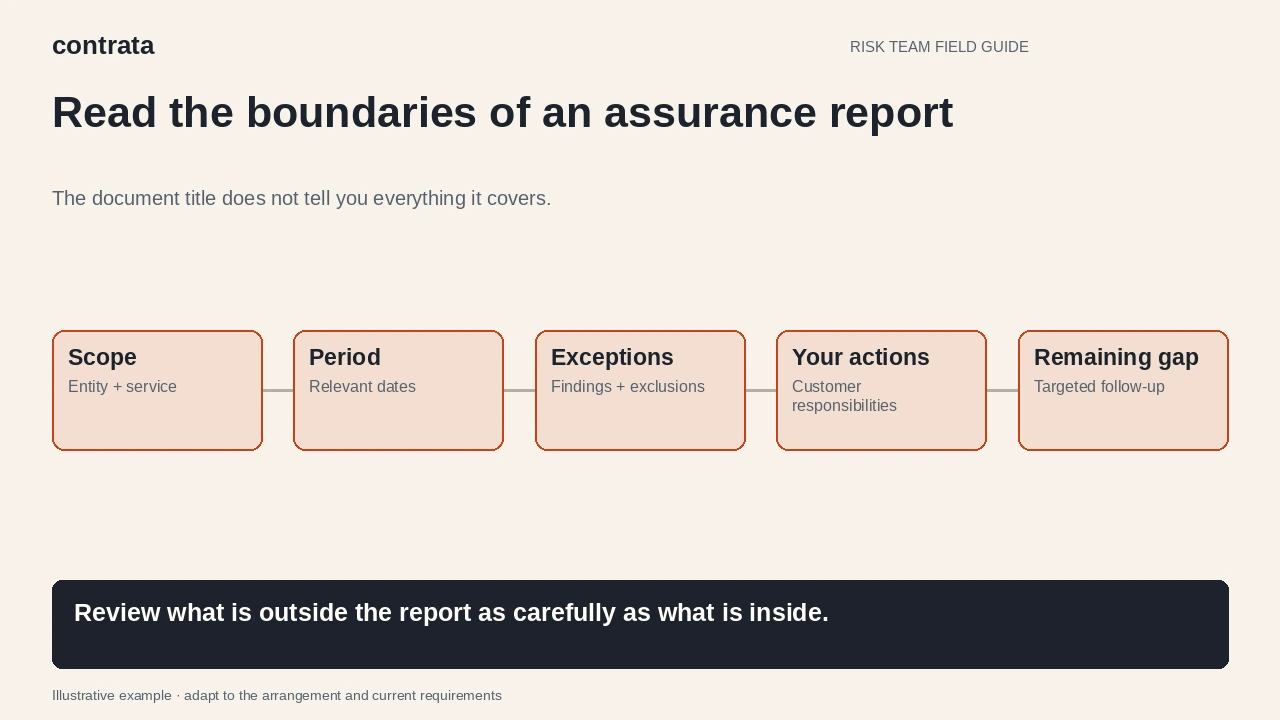
Identify the legal entity, service, systems and locations described in the report. Compare them with the arrangement you use. A familiar group logo is not enough to establish that the operating entity or service is included.
Then establish the report's period and the nature of the work performed. Read the report's own explanation of its scope and limitations. Different reports support different kinds of conclusions; avoid assuming that every assurance document tests operating effectiveness over time.
A useful opening note is short and factual: “This report concerns the provider's hosted customer platform for the stated period. Our separate document-processing service is not named in the scope and needs clarification.”
That note gives the next reviewer a service-specific starting point. “Assurance report received” does not.
Use a coverage worksheet
The following worksheet is an original review aid. Adapt it to the report type and the controls relevant to your organisation.
| Review area | What to establish | Follow-up if unclear |
|---|---|---|
| Provider identity | The legal entity and relationship to your contracting party | Ask the provider to explain the entity coverage |
| Service and systems | Which parts of your arrangement are included | Request a mapping to the service you receive |
| Period | The dates covered and relevant changes since then | Ask what changed and what evidence addresses the gap |
| Work performed | What was examined and what conclusion is expressed | Seek assurance-specialist interpretation |
| Exceptions | The finding, population or scope affected and response | Ask for impact and remediation evidence |
| External dependencies | Whether relevant subcontractor controls are included or excluded | Identify alternative evidence for excluded dependencies |
| Customer responsibilities | Controls or actions expected from your organisation | Assign and verify the internal owner |
| Limitations | Restrictions on reliance, distribution or interpretation | Follow the report's terms and obtain advice where needed |
Keep the worksheet linked to the report version reviewed. If the provider replaces the file, preserve the reference needed to understand the original decision under your retention process.

Fictional example: a favourable conclusion with an open question
A fictional superannuation trustee receives an assurance report for its administrator's member platform. Its review question concerns timely removal of access when staff leave the provider.
The report describes testing during an earlier period and includes an exception affecting the access-removal process. Management says a workflow change has been introduced. The trustee also learns that part of the support function moved after the report period.
The reviewer should not collapse those facts into “passed” or “failed”. The report provides evidence about the controls and work examined during its period. The exception and later service change create specific questions about the current arrangement.
The trustee asks which access population was affected, what the process change addressed, what validation has occurred and whether the new support model uses the same control. Those questions follow from the evidence rather than from a generic request for another certification.
Read exceptions for consequence
An exception needs context. Establish what control was tested, what the report says happened and how it relates to your service. Do not minimise a finding because it appears in a small table, or exaggerate it into a claim that every control failed.
Distinguish the assurance practitioner's findings from the provider's management response. A promise to fix a process is not the same evidence as subsequent validation of the fix. Where the response is important to your decision, request a clear update and determine what verification is appropriate.
If the report is difficult to interpret, ask a qualified assurance specialist. Avoid inventing a numerical risk rating from technical language you have not resolved.
Find the work left with your organisation
Some reports describe controls or actions expected from customers. Read those carefully and map the relevant ones to your own operating arrangements.
For example, the provider may expect customers to review access permissions or supply accurate information through an agreed interface. Your team needs to establish whether that expectation applies and whether the work is assigned and performed.
Create an internal action where ownership is unclear. Do not send the question back to the supplier if the missing evidence concerns your own process. A report can support only part of the control picture when your organisation's contribution remains unverified.

Address the period since the report
A report's date is not a simple expiry switch. Its usefulness depends on the period covered, changes since then and the question you are trying to answer.
Ask whether there have been relevant changes to the service, controls, delivery locations or dependencies. Consider what information can address the intervening period and what limitations remain. A provider statement may help explain changes, but it is not automatically equivalent to independent testing.
Document the conclusion at the strength the evidence supports. If current operation of a consequential control remains uncertain, name the gap and route it through your assessment process.
Finish with a reliance statement
The output of the review should say what you can use the report for, what you cannot establish from it and what follow-up is required.
A practical conclusion might explain that the report supports assessment of specified controls for the named service and period, while the changed support model and access-removal remediation need further evidence. It should identify the owner of those questions and the effect on the arrangement review.
For reports reused by different teams, the CPS 230 and CPS 234 evidence guide keeps each conclusion separate; targeted follow-ups can then address uncovered questions.
For organising the wider evidence record, see the CPS 230 evidence checklist. The assurance report's value is in the conclusions it can support within its boundaries, not simply in having a current-looking document on file.