Article
Exercise a general insurer’s outsourced claims disruption
Design a claims disruption exercise with realistic injects, manual queues, customer priorities and evidence of recovery beyond a system restart.
Contrata editorial team ·
The claims platform is back online. The provider calls the incident resolved. Your claims team still has handwritten intake notes, duplicate submissions and urgent cases waiting for assessment.
A useful disruption exercise tests that whole sequence. It asks whether the insurer can sustain the service people need, and how it knows normal work has resumed. A successful infrastructure restart does not answer either question.
The Business Continuity Institute's 2026 discussion of crisis exercising highlights the difference between exercises that reassure participants and exercises that expose weaknesses in decision-making. The claims scenario below uses that learning focus: each inject should reveal a decision, handoff or control that needs to work under pressure.
CPS 230 requires a systematic business continuity testing program, including an annual exercise. The scenario below is an original facilitation aid for one outsourced claims disruption. It is not a complete testing program or an APRA-prescribed script.
Start with a decision you want to test
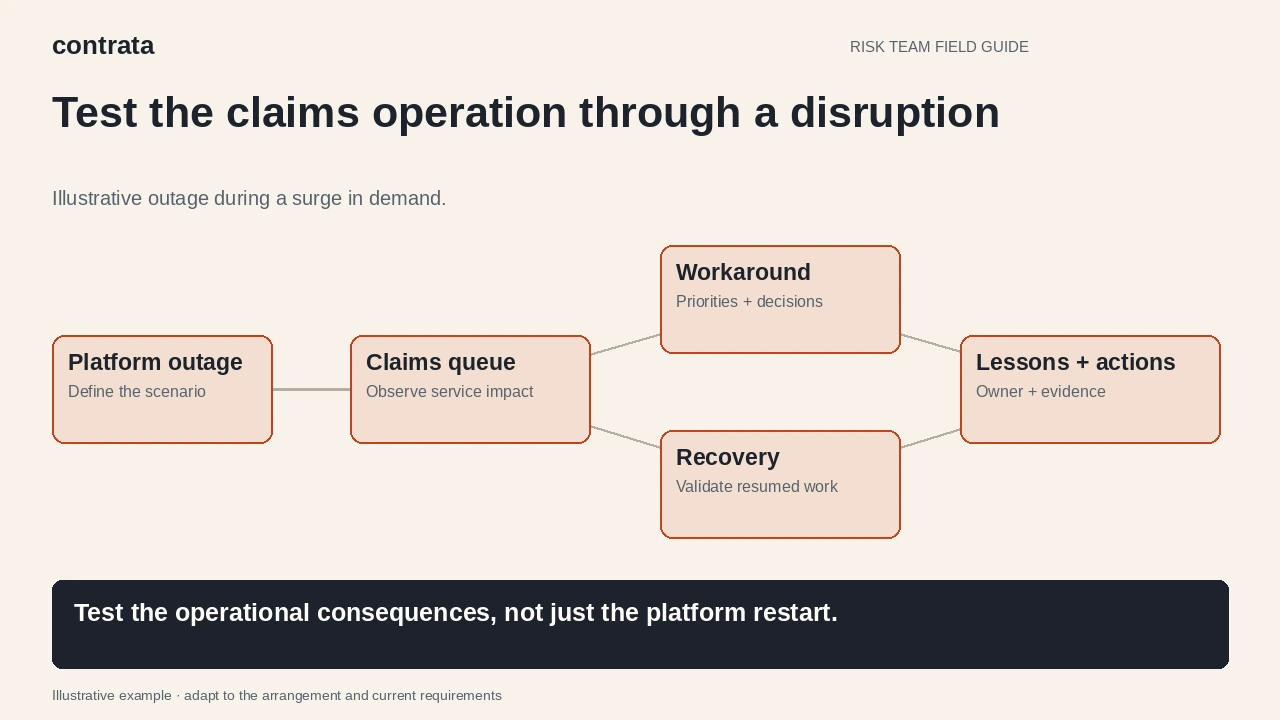
For a fictional general insurer, Harbour Cover, a storm increases claims demand just as its outsourced claims platform becomes unavailable. Telephone service remains available, but staff cannot reliably retrieve existing case records. The supplier has not confirmed a restoration time.
These are invented exercise assumptions, not a reported incident. The demand spike, timing and service constraints should be adjusted to your own credible exposure.
The exercise question is: can Harbour Cover prioritise incoming claims, retain reliable records and move work back into the platform without losing or duplicating instructions?
Bring the insurer's approved continuity plan and tolerance levels. Do not invent more convenient targets for the exercise. If participants cannot explain the measures or obtain the information needed to assess them, record that as a finding.
Set the boundary before the first inject
Define the claims types, channels, supplier services and customer groups in scope. Decide whether payment processing, external assessors and repair networks are included. A platform-only exercise may be legitimate, but it should not be reported as a test of the entire claims service.
Assign five functions, even if some people cover more than one:
- The facilitator controls the scenario and records assumptions.
- The claims lead decides how work is prioritised and allocated.
- The incident lead coordinates actions and internal escalation.
- The supplier representative provides service facts and recovery updates.
- An observer records evidence, decisions and unanswered questions.
Include technology, privacy, communications and risk advisers where their decisions are part of the scenario. If a key person is absent, test the delegated arrangement rather than pretending the absent person approved a decision.
Agree a safe exercise boundary. No real customer messages, live system changes or production-data exports should occur simply because an inject requests them. Use synthetic cases and clearly marked exercise communications.
Use injects that force choices
An inject is a piece of information introduced during the exercise. It should create a practical decision, not merely prompt participants to read the next paragraph of the plan.
Inject one: unclear outage scope. The provider says the platform is unavailable but cannot confirm whether submitted claims were saved. Ask who checks receipt records, what customer-facing staff can safely say and which assumptions need verification.
Inject two: competing customer needs. New claims arrive through telephone and web channels. Some callers need urgent assistance; others are checking an existing claim. Ask how staff identify urgent cases using the insurer's approved criteria, and how they avoid letting the easiest channel determine priority.
Inject three: workaround capacity tightens. The approved manual queue can accept new records, but only a limited number of trained staff can use it. Ask who can authorise additional resources and what evidence would show the workaround is falling behind.
Inject four: partial restoration. The supplier restores access to existing records but new submissions still fail intermittently. Ask whether normal processing can resume for any part of the service and how teams prevent conflicting instructions.
Inject five: backlog handback. The platform accepts new work again. The manual queue contains cases that customers also resubmitted online. Ask who reconciles them before downstream assessment or payment proceeds.
The facilitator can introduce these over a 90-minute workshop. That duration is a suggested discussion format, not a restoration target or regulatory threshold.

Observe tolerances through usable evidence
APRA's CPG 230 guidance connects testing with severe but plausible disruption and the ability to maintain critical operations. For this exercise, translate the insurer's own measures into questions the observer can answer.
Can the team identify when disruption began? Can it distinguish unavailable service from degraded service? What data could be missing? Which minimum functions remain available under the workaround? Who compares the observed position with the approved tolerances?
Record both the conclusion and its basis. “Within tolerance” is unsupported if nobody can establish the queue size or the oldest unallocated urgent case. “Not established because the manual queue lacks reliable timestamps” is more useful and should drive remediation.
Keep regulatory notification assessment with the designated incident and compliance owners. The exercise should test their access to facts and decision authority. It should not create a universal notification clock based solely on a supplier's first alert.
Give the manual queue controls of its own
In Harbour Cover's fictional exercise, staff record new telephone claims in an approved temporary queue. Each entry receives a unique reference, a receipt time, a responsible person and an urgency assessment. Access is restricted to the people handling the work.
The observer notices that existing-claim enquiries are being logged in free-text notes without a consistent link to the original claim. Those notes could be overlooked when the platform returns.
The action is specific: agree a required reference field, define the exception process when the reference is unknown and test retrieval by another staff member. “Remind staff to be careful” would leave the weakness intact.
Also test a staff handover. Ask the next shift to identify work completed, pending and escalated using only the queue. If an oral explanation is essential, the record may not yet support continuity.

Close recovery only after the work is accounted for
Harbour Cover's exercise ends with a duplicate claim: one entered manually and one submitted online after restoration. The receiving team must identify the duplicate, preserve the relevant history and prevent double processing.
Agree who can release the reconciled queue into normal workflow. Separate that decision from the supplier's declaration that the platform is operational. Record unresolved exceptions and how the insurer will keep them visible.
After the exercise, preserve the scenario, attendance, decisions, evidence and limitations. Assign each finding an owner and a testable closure condition. Retest the changed queue fields and handover using synthetic records, rather than closing the issue when the procedure is edited.
The recovery-backlog checklist develops the acceptance questions, while the supplier-incident intake guide helps structure the information needed during escalation.
The next exercise does not need more drama. It needs to establish whether the specific weakness found in this one has actually been fixed.