Article
Review a life insurer's material service provider contract
Connect a CPS 230 contract review to operational evidence, owners and tests, with a life insurance example and the limits of the 2026 NTSP relief.
Contrata editorial team ·
A contract can contain a right that nobody has practised using. A life insurer may be entitled to receive data on exit, for example, while its operations team has never checked whether the export can be reconciled or used by a replacement provider.
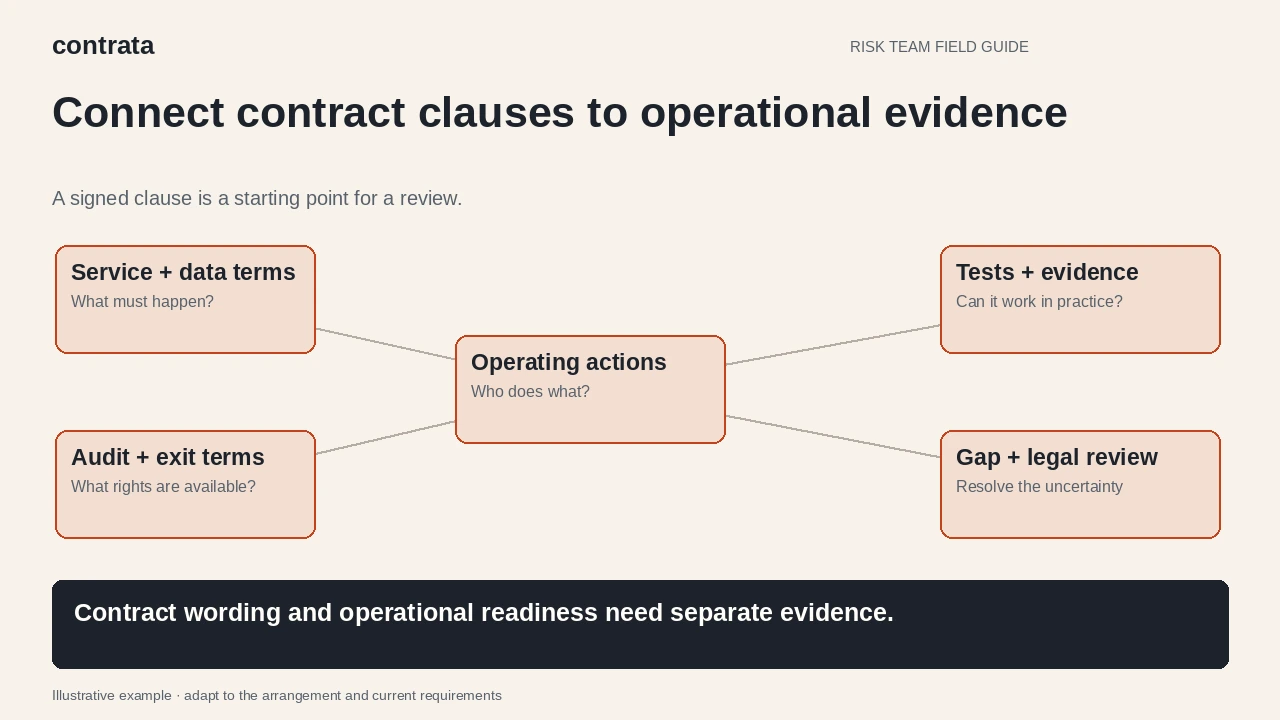
A useful material service provider contract review therefore needs two connected assessments: legal review of the agreement and operational review of how the arrangement will work. The second does not replace the first. It gives the legal and business teams concrete questions to resolve together.
This article offers a suggested review method using a fictional life insurer. It is educational guidance, not legal advice, model clauses or confirmation that an agreement meets every applicable obligation.
Review the whole arrangement
CPS 230's service-provider agreement provisions are the starting point for the regulatory review. Have qualified legal reviewers assess the applicable requirements and the agreement as a whole.
First collect the documents that define the service: master agreement, service schedules, amendments and relevant incorporated terms. Ask legal counsel to establish which documents control if they conflict. The risk team should not assume that a recent commercial summary overrides signed terms.
In the fictional example, Beacon Life uses an external claims administration service. The master agreement describes the relationship, a schedule defines the claims work and a later change document adds a data interface. The review needs all three to understand the operating arrangement.
Keep the service boundary beside the contract. Identify the decisions, records and customer interactions retained by the insurer. An agreement can be difficult to assess if reviewers are working from different assumptions about who performs the work.
Turn contractual topics into operating questions
The table below is an original review aid. It is deliberately not a complete list of CPS 230 clauses. Use it alongside legal advice and the current standard.
| Contract topic | Operational question | Evidence or exercise to consider |
|---|---|---|
| Service scope and measures | Can both parties identify what work is included and how performance is measured? | A sample report mapped to the actual claims workflow |
| Access and assurance | Who requests information and manages a review when it is needed? | Named contacts, request procedure and a previous example where available |
| Data handling | Can the insurer obtain understandable, complete records through the agreed route? | A scoped export and reconciliation exercise |
| Dependency changes | How does a provider notice reach the internal people who must assess it? | Notification routing and an example change record |
| Disruption cooperation | What information and support can operations obtain during an incident? | A joint scenario discussion and escalation test |
| Termination and transition | Can the insurer execute the proposed transfer or closure process? | Transition plan, responsibilities and a practical sample hand-off |
A missing operating procedure is not automatically a defective legal clause. A legal right that is too narrow is not fixed by an enthusiastic account manager. Record which kind of issue you have so the right team can address it.
Worked example: a data-export right
Beacon's operations team reads that data will be supplied on termination. Rather than treating that sentence as the end of the review, it asks how the process would run.
The proposed export contains claims records, but the team has not established whether it includes associated documents, decision history and unresolved exceptions. The provider's explanation uses a different record count from Beacon's own system. The review records the discrepancy without assuming either count is correct.
The next step is a small, appropriately controlled sample exercise. Operations defines the records needed, technology reviews the format and legal checks the relevant contractual position. Privacy and security controls apply to any real information used; the exercise should not spread sensitive claims data unnecessarily.
The team then compares the export with the expected source records, tests whether relationships between records remain usable and records any omissions. Successful delivery of a file is only one part of this check. The insurer needs to understand what it received and whether it can use it for the intended transition.
The resulting finding might be: “The sampled core records reconciled. Supporting-document links require a separate transfer process that has not yet been demonstrated.” That is more useful than marking “exit clause present” in a checklist.

Track obligations on both sides
Some operating problems arise because the insurer does not perform its own agreed tasks. The provider may need timely approvals, accurate input files or a named contact to complete the service.
For each obligation worth tracking, record the responsible party, internal owner, trigger, evidence and escalation route. Avoid creating a register so detailed that nobody maintains it. Start with obligations whose failure could materially affect service delivery, oversight or the ability to respond to disruption.
Beacon assigns one owner to check recurring performance information and another to coordinate significant changes. Both know where the signed documents are held. When a report changes format, the service owner checks whether the new version still answers the intended questions rather than filing it automatically.
Keep legal exceptions and operational gaps separate
Use different issue categories for:
- A legal question requiring interpretation or negotiation.
- A missing or inconsistent document.
- A contractual provision with no working procedure.
- A procedure that exists but has not been tested.
- Evidence that the agreed process is not operating as intended.
The distinction helps approvers understand the response required. “Review incomplete” is too broad to guide action. “Legal review of the incorporated terms remains open” or “the transition contact procedure has not been exercised” is more precise.
A negotiated change also needs an implementation owner. Once signed, update the relevant procedure, reporting request or test plan. Otherwise, the operational team may continue using the old arrangement.
Apply the 2026 NTSP relief narrowly
APRA's 30 April 2026 response explains limited relief for specified requirements. It applies where the provider falls within a listed exempt category and the arrangement uses standardised terms or has no formal agreement. Other CPS 230 obligations remain.
A supplier offering non-negotiable terms does not, by that fact alone, qualify. Do not apply the relief to an ordinary claims administrator simply because negotiation is difficult. Check the current standard's attachment and any relevant written APRA exemption with the appropriate legal or compliance reviewer.
CPG 230 also explains that exemptions should, where practicable, target the specific provisions that cannot reasonably be satisfied. Record the basis and scope of any relief relied on; do not label the whole relationship “exempt” and stop reviewing it.

Finish with a usable handover
The contract review should leave the service owner with the signed document set, a short summary of relevant operating responsibilities and a list of unresolved matters. Each open item needs an owner and evidence-based closure condition.
Where a contractual requirement may be affected by the 2026 changes, use the non-traditional provider relief review to check the arrangement and the precise requirements involved.
For Beacon, the immediate action is to establish the supporting-document transfer process and test it within an appropriate controlled scope. Legal review continues on its own questions. The contract record and operational evidence remain linked, so the next reviewer can see both what the parties agreed and what the insurer has actually established.