Article
CPS 230’s 2026 non-traditional provider relief: what to check
Check the conditions for non-traditional service-provider relief, document the specific obligations affected and retain operational oversight.
Contrata editorial team ·
A provider refuses to amend its standard contract. That fact alone does not establish eligibility for CPS 230's non-traditional service provider relief.
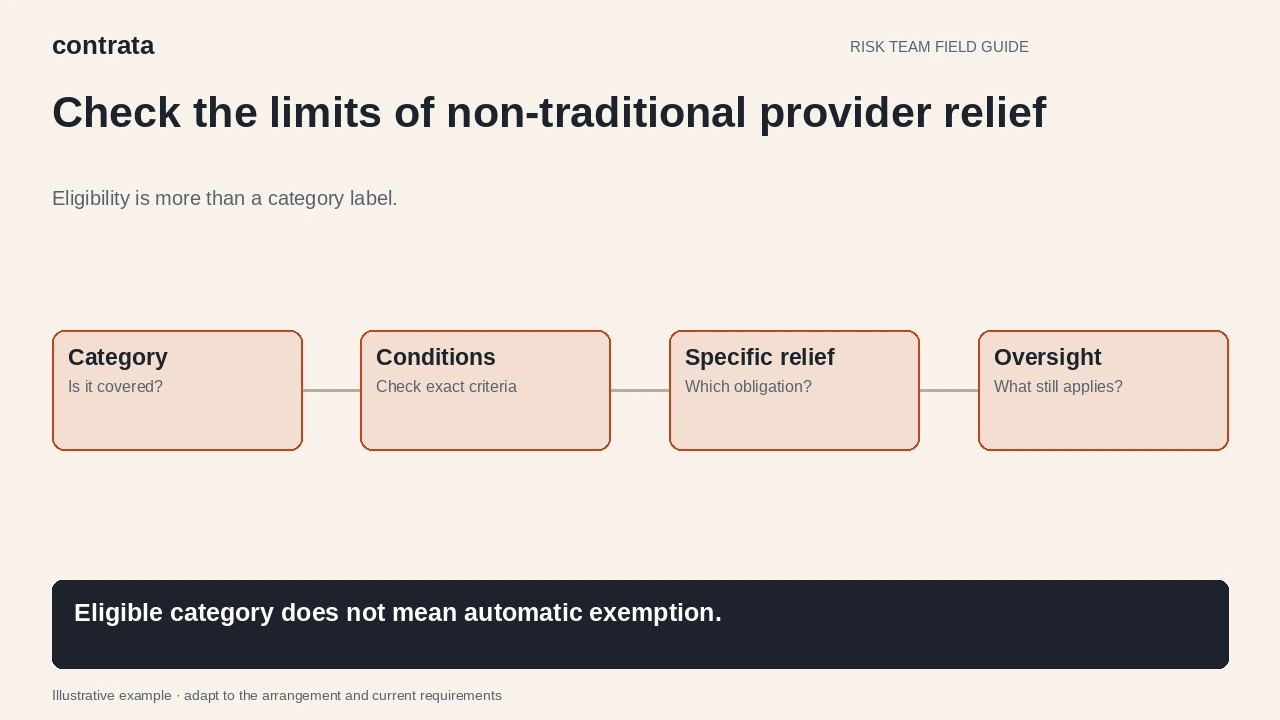
The review needs two separate questions: does the provider fit an eligible category, and does the arrangement satisfy the relevant condition about its terms? Only then should the team determine which requirements are affected and what oversight continues.
APRA finalised the amendments on 30 April 2026, with effect from 1 July 2026. This is an explanation of the current framework, not a new announcement. The practical workflow below is an editorial review aid; legal and risk owners should assess the actual arrangement.
Start with the precise arrangement
Use the legal provider identity, the service being supplied and the terms that apply to that service. A recognisable provider name is not enough. A group may supply several services through different entities and contractual structures.
In a fictional example, a small Australian regulated entity uses a clearing service through an organisation called Southern Settlement Infrastructure. The risk team has received a request to mark the relationship exempt. The name and scenario are invented, and no conclusion about any real provider is implied.
Before changing the record, the reviewer asks for the operating entity, the exact service, evidence of the relevant licensing or oversight status and the version of the applicable rulebook or terms. Those documents define what is being assessed.
The organisation's small staff count does not create this relief or establish non-SFI status. Eligibility comes from the regulatory conditions, not the size of the reviewing team.
Check both conditions against the current source
Under the current CPS 230 text, paragraph 57 links relief to an Attachment category and to standardised terms or the absence of a formal agreement. It identifies paragraphs 53, 54, 55(d), 59(a) and 59(c). Use the current numbering when recording the decision.
APRA's finalisation letter lists the categories: government agencies, regulators, central banks, financial market exchanges, clearing and settlement facility operators, payment system and scheme operators, and financial messaging infrastructures. The definitions matter. For example, the government-agency category does not extend to government business enterprises. Check the full Attachment rather than relying on these short labels.
A large supplier's market power does not itself put it on this list. Nor does the phrase “standard contract” settle whether the condition is met. Examine the entity's actual ability to negotiate the relevant rights and obligations.
In the fictional clearing-service review, the reviewer records the evidence for the category separately from the evidence about contractual terms. If either is unclear, the conclusion remains unresolved. Combining them into one yes/no question would make it difficult to see what still needs legal review.
Work out what can still be satisfied
CPG 230's NTSP guidance expects targeted use of exemptions where practicable, limited to provisions that cannot reasonably be satisfied. It also discusses a specific exemption application where the conditions are not met. Treat that guidance separately from the binding standard.
For each relevant obligation, the review record can ask:
- What does the existing agreement, rulebook or operating arrangement already provide?
- What requirement cannot be met, and why?
- What evidence supports that limitation?
- Which precise paragraph is being considered for relief?
- Who has reviewed the conclusion and what would cause it to change?
This is a suggested working record, not an additional APRA form. It is more useful than a single relationship-level label because it preserves the reasoning and prevents the exemption from spreading to unrelated services.
Suppose Southern Settlement Infrastructure provides service-performance reports but will not negotiate bespoke audit terms. The team should preserve and use the available reports. It should not stop reviewing performance merely because another contractual provision cannot be negotiated.

Retain a service-risk picture
APRA's finalisation letter makes clear that the relief is limited and other CPS 230 requirements continue. It does not remove the operational dependence.
In practical terms, the fictional entity still needs to understand what happens if the clearing service becomes unavailable. Which transactions would wait? What information would operations need? Which internal processes depend on the service's opening hours or recovery communications? Who would assess the consequences of a prolonged interruption?
The answers might differ from those for a conventional outsourced software provider. A replacement may not be readily available. An individual customer's influence over infrastructure may be limited. Record those constraints honestly and design the response around the choices the entity actually has.
Do not describe an unavailable substitute as an exit plan. Describe the limitation, the operational consequences and the contingency actions that can be taken. Escalate any unresolved issue through the appropriate risk and legal process.
Use evidence that is actually obtainable
A provider may publish operating rules, status information, annual reports or regulatory disclosures. It may also share documents with participants through established channels. Identify which sources answer the questions in your review and how current they are.
Avoid treating public regulatory oversight as proof that the entity's own continuity assumptions are correct. Oversight is relevant context; it does not demonstrate that your internal queue, communications and reconciliation processes will work during an interruption.
For Southern Settlement Infrastructure, the service owner assembles the current operating timetable, incident communication arrangements and the entity's own failed-transaction handling procedure. Operations walks through a missed processing window using synthetic instructions. Risk records the limits of available supplier information and the decisions affected by those limits.
This gives the team something useful to inspect even where bespoke documents are unavailable.

Keep the decision reviewable
A concise decision record should identify the service and legal entity, cite the current source, attach evidence for both eligibility conditions and describe the exact relief relied on. Add the reviewer, decision date, unresolved questions and triggers for reassessment.
Keep material arrangements visible in the relevant register and risk records. APRA's CPG 230 guidance addresses retained monitoring and register treatment for NTSP arrangements. Relief should not make the service disappear from internal reporting.
Useful review triggers include a change in the contracting entity, service scope, terms, licensing evidence or available information. A new service from the same group deserves its own analysis rather than inheriting the earlier conclusion automatically.
The decision-record guide provides a practical structure for documenting the eligibility assessment, remaining uncertainty and continuing oversight.
For a team reviewing existing records, start with entries labelled simply “exempt”. Pick one and ask whether another reviewer could identify the two eligibility conditions, the specific requirements affected and the oversight that continues. If not, repair the decision record before relying on the label.