Article
Write a third-party risk decision someone else can challenge
Document a supplier-risk decision with options, assumptions, authority and review triggers. Includes a worked conditional-renewal example for a super fund.
Contrata editorial team ·
“Approved with actions” tells the next reviewer very little. Which risk was accepted? What other options were considered? What has to happen before the approval can be relied on?
A useful third-party risk decision record answers those questions while the people making the decision still remember the discussion. For a super fund, it also separates the service owner's recommendation from the authority that can make the decision.
The format below is a suggested internal record. It does not create permission to accept a regulatory breach, replace legal advice or establish that a supplier meets all relevant obligations.
Define the decision narrowly
Start with the action requiring a decision: enter an arrangement, renew it, change its scope, impose conditions, fund remediation or begin an exit assessment. Name the service and the proposed period or change.
“Approve the supplier” is usually too broad. A provider may deliver several services, and an assessment of one arrangement may not support another. If classification is unresolved, first work through the relevant materiality questions; the superannuation material-provider guide covers that separate task.
Then state what the decision will allow. If renewal is conditional, explain whether conditions must be met before signing, before a new service begins or during a tightly controlled follow-up period. Those distinctions affect what the business can do next.
Show the evidence that pulls in different directions
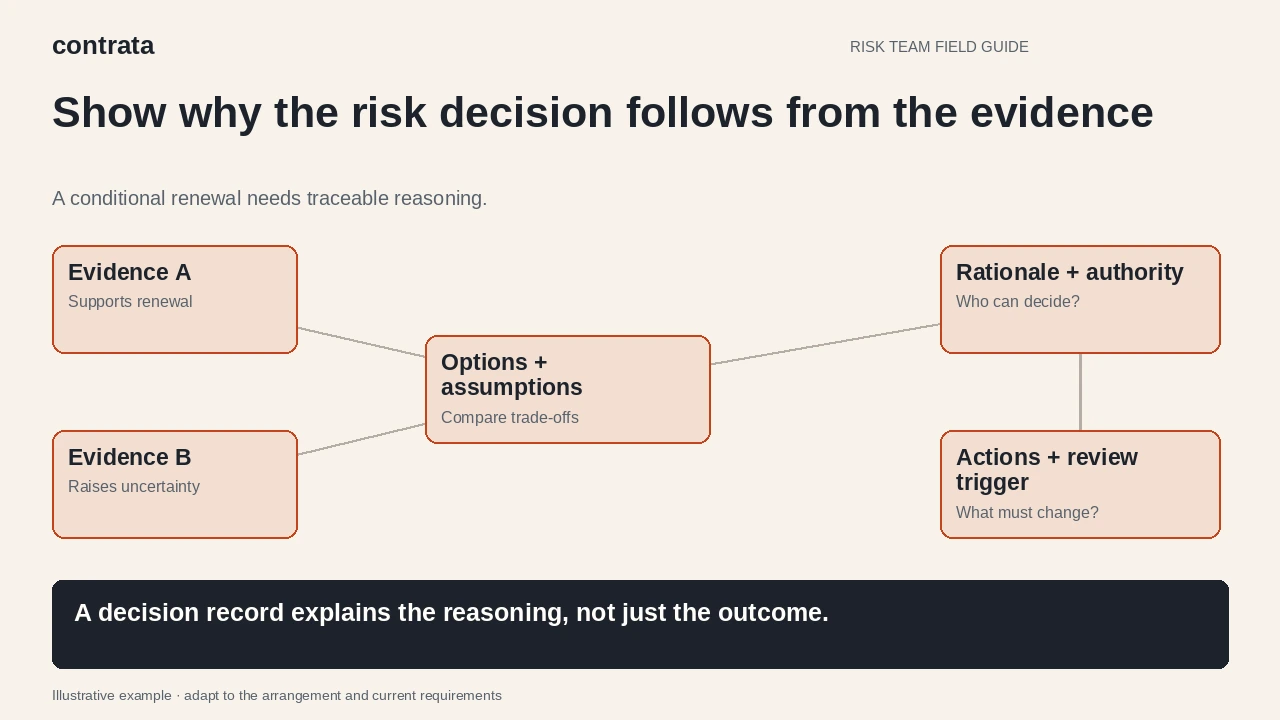
A fictional fund is considering renewing an administration arrangement. The provider has completed a recovery exercise and supplied a satisfactory technical summary. The fund's operations team says the exercise did not demonstrate how interrupted contribution records would be reconciled.
Both observations can be true. The decision record should preserve them, identify the scope of the test and explain why the missing reconciliation evidence matters to the fund's service.
A weak rationale says: “Recovery testing completed; residual risk accepted.”
A more useful rationale says: “The supplied exercise supports restoration of the tested platform. It does not demonstrate reconciliation of interrupted contribution records. Operations has identified the reconciliation evidence needed to assess the fund's recovery assumptions. The renewal proposal remains subject to the decision and conditions set out below.”
This wording does not manufacture a conclusion. It establishes the question the authorised decision-maker must resolve.
Compare real options
List the feasible options and their consequences. In the example, they might include seeking further testing before a decision, changing the proposed service scope, considering a legally available short extension, or investigating an alternative arrangement. Their availability depends on the facts and contract; none should be presented as automatically permissible.
For each option, record:
- The service consequence and affected beneficiaries or operations.
- Evidence supporting its feasibility.
- Important assumptions and unresolved questions.
- Resources and dependencies needed to carry it out.
- Legal, operational or contractual constraints requiring specialist advice.
Avoid a comparison in which the preferred option receives detailed analysis and every alternative is dismissed with “too difficult”. If an exit cannot be completed safely within the relevant period, explain what evidence supports that conclusion and what preparation is missing.

Separate a recommendation from a decision
The service owner can explain operational consequences. Risk can challenge the assessment. Legal can advise on contractual or legal constraints. The authorised person or committee records the actual decision under the organisation's governance arrangements.
CPS 230 places oversight accountability with the Board and requires clear senior-management responsibilities. APRA's CPG 230 discusses documented delegation and escalation. Neither gives this article's example record the status of a mandated form.
Capture who recommended, who challenged and who decided, with the date and the relevant delegated authority. If approval depends on another committee's decision, leave that dependency explicit. Do not convert a meeting discussion into approval merely because nobody objected.
Make conditions testable
“Improve recovery evidence” leaves room for disagreement about completion. A stronger action identifies the missing capability, the evidence required, the owner who will obtain it and the person who will assess it.
For the fictional fund, that could mean a documented reconciliation walkthrough covering interrupted files, duplicate handling and completion checks. The operations reviewer would determine whether the evidence supports the proposed recovery approach. The record would specify the agreed due date and the escalation if the evidence is inadequate.
A completed upload should not automatically close the condition. The decision may depend on what the evidence demonstrates, not whether a file exists.

Record what would reopen the decision
Review triggers should follow the assumptions used. A change to the administration platform, a relevant incident, an unsuccessful exercise or a missed condition may undermine the original reasoning.
Keep the original decision intact and add the subsequent review. Silent edits make it difficult to distinguish what was known at approval from what emerged later.
Before filing the record, ask a colleague who was absent from the meeting to explain the decision back to you. They should be able to identify the proposed action, unresolved risk, authority, conditions and next review trigger without an oral briefing. If they cannot, add the missing reasoning rather than another attachment.
For decisions with conditions, use evidence-based closure criteria; for decisions requiring Board attention, carry the rationale into a decision-focused report.
For the underlying source inventory, use the CPS 230 evidence checklist. The decision record's job is to explain how that evidence led to a particular action.