Article
Test a super fund administrator exit before you need it
Run an administrator exit tabletop that checks data extraction, reconciliation, handoffs and destination readiness before a real transition.
Contrata editorial team ·
A super fund can have a termination clause and still be unable to move its administration service safely. The missing piece may be an export that leaves out case history, a replacement platform that cannot read the files, or an approval nobody knows how to obtain during a dispute.
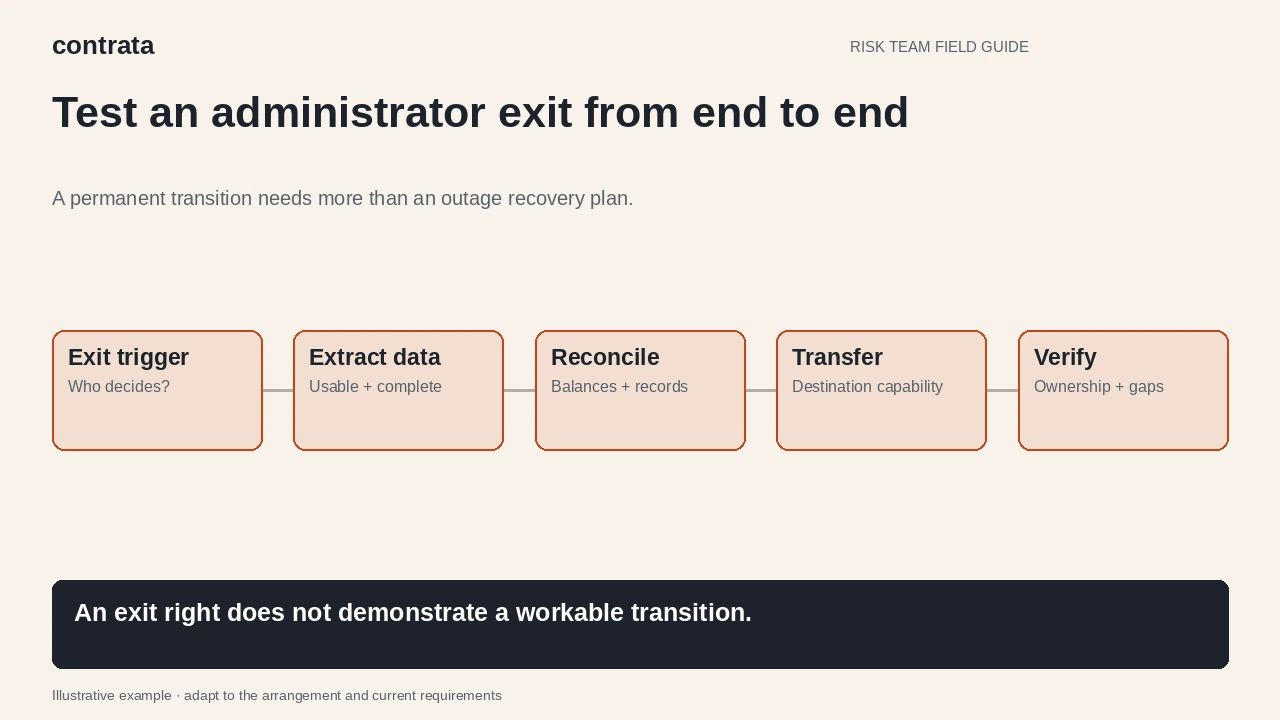
An exit tabletop should uncover those obstacles while the fund still has choices. It is a structured discussion using evidence and decision points, followed by targeted practical tests. It does not prove that a migration has succeeded.
CPS 230 requires an orderly-exit capability for material arrangements. The exercise below is an original planning aid, not an APRA template or a prescribed exit timescale. It addresses changing administrators, rather than restoring the existing service after an outage.
Choose the exit you are testing
An orderly replacement at contract expiry gives the team different options from an administrator that suddenly cannot operate. Define which situation the exercise covers. If the plan assumes cooperation, access to staff and months of preparation, say so. A later exercise can remove those assumptions.
For this fictional example, Wattle Super intends to replace its administrator at the end of the contract. The incumbent remains operational, but its specialist migration team is shared with other clients. The destination is a proposed administrator, not yet a proven replacement. All organisations and circumstances in this example are invented.
The exercise question is precise: can Wattle identify the evidence, people and decisions needed to transfer member administration without losing control of outstanding work?
Set the scope to include member records, contribution allocations, benefit-payment instructions, open enquiries, exceptions and the documents needed to interpret them. Record excluded services and who will examine them separately. A narrow scope is useful only if the boundaries stay visible.
Bring the people who own the handoffs
Invite operations, technology, information security, risk, legal and the person authorised to direct the transition. Include the incumbent and destination where appropriate. If a supplier cannot attend, record which answers remain assumptions rather than speaking on its behalf.
Ask participants to bring the current exit plan, contract provisions relevant to transition, data dictionary, sample export specification and open-work report. Use synthetic records for the discussion. Any later test involving real member information needs its own authorised security, privacy and access arrangements.
Give the facilitator permission to challenge statements such as “the supplier will handle that”. The follow-up is: which person, using which process, with what evidence that the next team can accept the output?
Keep a separate decision log. Discussion notes capture what people said; the decision log identifies what the fund has actually authorised and what remains unresolved.
A practical tabletop agenda
The following timing is an illustrative workshop design, not a regulatory requirement.
- First 15 minutes: confirm assumptions. Establish the exit trigger, service scope, destination and decision authority. Name the person who can pause the transition.
- Next 25 minutes: walk the extraction. Identify each data set, export format, access dependency, owner and delivery method. Ask how records changed after the initial export will be captured.
- Next 25 minutes: reconcile and receive. Follow a synthetic member record, an unresolved enquiry and a pending transaction into the destination process.
- Next 15 minutes: introduce a problem. The incumbent can export balances but cannot deliver historical case attachments in the agreed format. Decide what must happen before progressing.
- Final 20 minutes: assign evidence and decisions. Record gaps, interim controls, acceptance criteria and who will verify the next test.
Do not squeeze every uncertainty into a single meeting. The output should include a small number of concrete follow-on tests, not a declaration that every participant was comfortable.

Test what the export leaves behind
Wattle's fictional sample export contains account balances and transaction totals. It omits documents attached to unresolved benefit cases. The receiving team can import the structured files, but cannot explain why some instructions are on hold.
A file-count check would miss the operational problem. The team needs to know whether the destination can continue the work correctly.
For each selected record type, ask:
- What does the receiver need to understand its current state?
- Are identifiers consistent across structured records, documents and correspondence?
- How are changes between initial extraction and final transfer identified?
- Can the receiver distinguish completed, cancelled and pending instructions?
- Who investigates a mismatch, and where is the resolution recorded?
In this example, operations requests a linked export of case metadata and attachments. Technology checks the identifier mapping. The receiving administrator demonstrates how a synthetic case appears in its work queue. The unresolved gap remains open until that demonstration supports the agreed acceptance criteria.
Make each handoff an explicit acceptance point
Avoid one broad sign-off for “data migrated”. Separate the decisions.
Extraction accepted: the agreed data sets and date ranges are present, their limitations are documented, and transfer controls are confirmed.
Reconciliation accepted: defined balances, counts and sampled work items agree, or exceptions have an authorised treatment. Specify what was compared; a statement that reconciliation passed is too vague.
Service readiness accepted: the destination has access, people, instructions and escalation routes to continue the in-scope work. An import that technically succeeds is only part of this decision.
Cutover authorised: the accountable decision-maker has the evidence, knows the unresolved risks and understands the fallback. If rollback is proposed, test whether new transactions can actually be reconciled back to the old service.
Old access and records addressed: retention, retrieval, access removal and disposal decisions follow the applicable obligations and approved arrangements. Do not assume that ending the service means deleting every record immediately.

Finish with gaps that can be closed
For Wattle, “improve data portability” is not a useful action. A better record names the missing case attachments, the person responsible for the revised export, the receiving team's acceptance test and the decision that cannot proceed until it passes.
Keep the initial observation, agreed fix, test result and closure decision together. If the new test covers only one record type, do not close gaps affecting all other types.
APRA's CPG 230 guidance discusses exiting procedures and alternative arrangements within service-provider management. Use that context alongside the fund's actual contracts and operational design; contractual interpretation should involve the legal owner.
Use the backlog and reconciliation guide to challenge recovery acceptance, then track unresolved improvements through evidence-based remediation closure.
A lean team can start with one difficult handoff this month: ask the proposed receiver to explain how it would resume an unresolved case from the available export. If it cannot, the next exit-readiness action is already clear.