Article
Close supplier remediation actions with evidence
Separate a promised fix from verified remediation, with an access-control example, practical closure criteria and clear reopening triggers.
Contrata editorial team ·
The provider says an issue is fixed. The action owner updates the tracker to complete. At the next review, nobody can explain what changed or what evidence showed that the problem had stopped occurring.
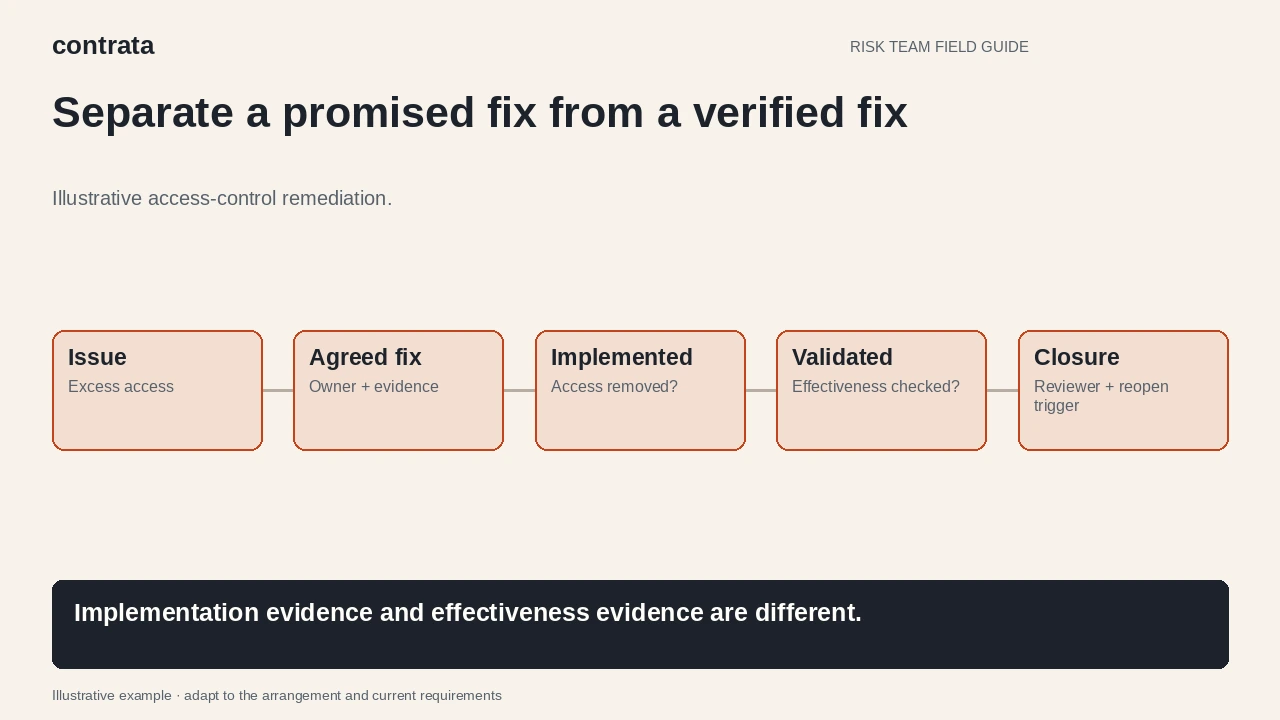
A remediation record needs to distinguish the commitment to act, implementation of the fix and validation of its effect. Those stages may require different people and different evidence. Closing them all at once can hide work that remains unfinished.
This article presents a suggested closure workflow for supplier-risk actions. The access-control example is fictional. The process is an editorial aid, not an APRA-prescribed status model or permission to leave a serious issue unresolved.
Define the issue before agreeing the fix
Write the finding as an observable problem and its consequence. “Access management needs improvement” is too broad to establish when remediation is complete.
In the fictional example, an organisation finds that the provider's removal process did not consistently disable former staff access to a support tool. The review has not yet established the full affected population or whether any unauthorised activity occurred.
Keep those questions separate. Remediation of the access-removal process does not by itself resolve investigation of possible past use. Both may need action through the appropriate security and incident processes.
For APRA-regulated organisations, consult CPS 230 and CPS 234 for the applicable control, remediation and escalation obligations. The workflow below supports clear administration; it does not determine whether an issue is legally acceptable or which notifications apply.
Agree what closure would demonstrate
Before the provider starts work, establish the intended outcome and what evidence could show it. The closure criterion should address the finding, not merely require delivery of a document.
For the fictional access issue, a plan might include identifying and addressing the affected access population, correcting the process that allowed the delay and validating that the revised process operates as intended. Security specialists determine the appropriate technical actions and testing scope.
Avoid prescribing an arbitrary sample size or waiting period simply because it fits a template. The validation approach should reflect the control, the issue and the risk. If the team lacks the expertise to judge sufficiency, assign a qualified reviewer rather than accepting the provider's assurance at face value.
Use statuses that describe evidence
A short status model can make the work visible:
| Status | Meaning in this suggested workflow | Evidence expected |
|---|---|---|
| Action agreed | The response, owner and target date are defined | Agreed plan and closure criteria |
| Implementation reported | The provider says the change is in place | Change record and explanation of scope |
| Validation pending | The team has not yet established the intended outcome | Defined validation work and reviewer |
| Validation completed | Results are available and limitations are recorded | Test or review findings |
| Closed | The authorised reviewer accepts that the closure criteria are met | Recorded decision linked to evidence |
If validation fails, retain the result and revise the action. Do not reset the issue as though the earlier attempt never happened.
The statuses are not a compulsory system design. Their purpose is to prevent “the provider sent an email” from meaning “the control is effective”.

Worked example: a new workflow is only part of the answer
The provider introduces an automated access-removal workflow and sends a screenshot showing it is enabled. The internal action owner records implementation reported.
The screenshot establishes that a configuration exists. It does not, on its own, establish whether the right events trigger it, whether all relevant accounts are covered or what happens when the automated step fails.
The reviewer asks for evidence addressing those points. The provider explains that one support-tool account type sits outside the automated route. A separate manual step is needed. The action therefore remains open while the team assesses the remaining process and its operation.
This is not an argument against automation. It is a scope check. The new workflow may solve much of the problem while leaving a relevant part untreated.
Separate provider actions from your own actions
Your organisation may need to update contacts, change its access-review process or improve the information it supplies to the provider. Track those internal tasks alongside the supplier's work without making the provider responsible for them.
A useful action record contains:
- A clear finding and the arrangement affected.
- The cause being addressed, including uncertainty about the cause.
- The agreed change and any temporary protections.
- Named provider and internal owners.
- Dependencies that could delay implementation or validation.
- Closure evidence, reviewer and decision authority.
- The effect of a missed date and the escalation route.
Where several actions address one finding, keep a parent finding open until the relevant closure decision is made. Closing one component should not make the overall issue disappear from reporting.
Treat missed dates as new information
A due date can pass because of a dependency, an ineffective approach or a lack of capacity. Ask what changed and what the delay means for exposure. Updating the date without that assessment loses useful risk information.
The authorised decision-maker may need to consider alternative treatment, restrictions, escalation or changes to the arrangement. Risk acceptance, where permitted by your governance framework, is a separate decision from successful remediation. It must not be used to imply that the underlying problem has been fixed or that mandatory obligations no longer apply.
Keep any temporary measures visible, with their own owners and limitations. A temporary control may reduce exposure while work continues, but its effectiveness still needs a basis.

Close with a reasoned decision
A closure note should explain what was reviewed and why it meets the agreed criterion. It should also state material limitations.
For example, the fictional reviewer might record that the revised workflow and manual exception process were examined within the agreed scope, that the identified population was addressed and that the validation results supported closure of the process-remediation action. Any separate incident investigation would retain its own status.
Avoid a bare “closed, evidence received”. The person reading the record later should be able to identify the evidence and understand the decision without reconstructing the entire email chain.
Decide what would reopen the issue
Define meaningful reopening triggers, such as recurrence of the same failure, evidence that the fix omitted part of the service or a change that invalidates the validation basis. Link those triggers to ongoing monitoring where practical.
Where a gap remains accepted rather than fixed, the decision-record guide helps distinguish a documented risk decision from evidence that the remediation succeeded.
The next service review can then check whether the fix remains relevant, instead of repeating the original assessment from scratch. For a broader evidence record, use the CPS 230 evidence checklist. For this action, the immediate question is whether the record demonstrates the agreed outcome, not merely that somebody completed a task.