Article
After Railway’s key revocations, reconcile the recovery
Railway says later API-key revocations were precautionary. Match each notice to the affected integration and verify the recovery without assuming a new breach.
Contrata editorial team · Published · Prepared on

Retrospective analysis of the October incident and recovery notices, originally drafted 25 October and refreshed 31 October 2026.
Railway says some replacement API keys were inadvertently included in a later round of precautionary revocations following its October security incident. It marked the clarification notice resolved on 25 October at 06:26 UTC. That closure does not establish whether each customer completed the earlier recovery work.
The clarification posted on 24 October at 13:57 UTC, or 25 October at 00:57 AEDT, says the later revocations were not a new security incident. Railway explains that a batch supplied to OpenAI and Anthropic could not be filtered by creation time and consequently included newer keys. It says those revocations do not indicate that replacement keys were compromised.
The separate recovery status channel was still in monitoring at its latest visible update when checked on 31 October: 29 October at 15:45 UTC (30 October at 02:45 AEDT). Railway said signups remained paused and it had no reopening date to share, while reliability for existing customers remained its priority. That notice had scheduled a further update by 16:00 UTC on 30 October; it was still the latest entry visible at this source check. This is recovery from the October incident, not an announcement of another incident. Do not infer complete recovery from an earlier restoration statement or a scheduled update time.
The practical supplier-risk question is which integrations need attention now, who owns that work and what evidence will establish that the affected service works again. The workflow below is an editorial suggestion for coordinating that review, not a finding about any particular customer's exposure.
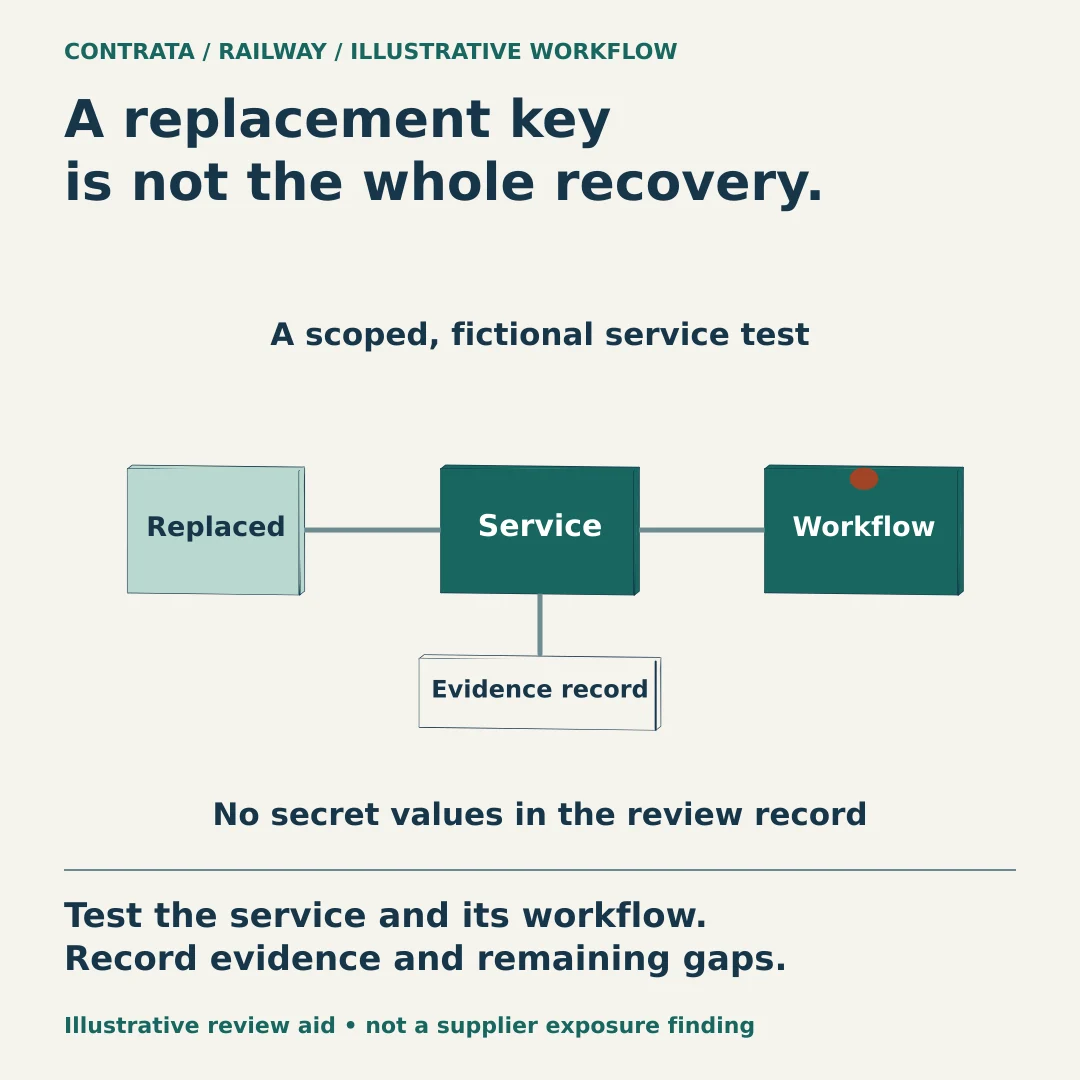
Illustrative workflow. No secret values needed.
Separate the clarification from the original incident
Railway's initial disclosure on 21 October described possible access to encrypted customer environment variables and decryption of some contents. It advised rotating stored environment variables, including API keys, and private-registry credentials, and checking relevant service logs.
Its preliminary report dated 22 October says the attacker accessed internal systems and that some stored variables were decrypted. It also says the forensic investigation remained ongoing. These are Railway's reported findings; the report does not establish the precise exposure of every customer.
The later clarification addresses a different question: why another key may have stopped working after a customer had already replaced it. Keep the original incident response and the later operational recovery linked, but do not turn a precautionary revocation into evidence of another attack.
Match the notice to a service and owner
Ask the relevant technical owner to reconcile provider communications with the integrations your organisation or supplier operates. Use the provider's authenticated console or established support route to validate the notice. The supplier-incident intake guide can help organise that initial record. Do not copy a secret into a risk register, meeting note or evidence request.
A compact record can identify the provider, affected service, non-secret key identifier, notice time, technical owner and current action. Include whether the notice concerns an original credential or a replacement. Where the answer is uncertain, record that uncertainty instead of inferring the sequence from a failed request alone.
For an outsourced service, ask the supplier to explain the customer-facing consequence. An integration failure might interrupt a task even while the main application remains available. The service owner needs the operational picture, not just confirmation that somebody created a key.
Apply the right recovery branch
For a key that a provider revoked, Railway's 24 October clarification instructs customers to create a replacement, update the corresponding environment variable and redeploy the services using it. For keys still working, that notice does not require repeating completed rotations. Railway clarification
This distinction does not cancel unfinished work from the original incident. Have the technical owner determine which earlier actions remain outstanding and which later notices require a separate change.
Use your approved change process. Identify the systems that use the credential before updating them, coordinate the change with the relevant owners and avoid creating competing replacements that nobody can trace. The risk team should request evidence of controlled completion without asking to see the credential itself.
Verify the integration, then the service
A replacement being accepted by the provider is useful evidence, but the service owner should also confirm the intended workflow. Did a representative authorised transaction complete? Did scheduled work resume? Does the change leave any failed or pending work requiring reconciliation?
Keep those checks proportionate to the affected service. A fictional supplier might demonstrate that its learning-platform integration can retrieve a course result, then confirm whether jobs missed during the interruption need replay. That example is a proposed recovery check, not a reported Railway customer outcome.
Record the relevant test, time, result and reviewer. Track remaining failures separately rather than closing the whole issue because one connection succeeds. Where interrupted work needs reconciliation, use the separate recovery-beyond-the-restart guide for the backlog review.
Close against evidence, not the headline
The handover should show which notices were reviewed, which changes were made, which old credentials were revoked or disabled as required, and which service checks passed. Record remaining investigation questions and a named owner for each.
Recheck Railway and the relevant providers before relying on a recovery summary. A status clarification can explain a symptom; your own service evidence establishes whether the necessary work is complete.