Article
From supplier evidence to a reviewable risk report
Use a clear report brief, preserve evidence qualifications and review the final handover before colleagues rely on the result.
Contrata editorial team · Published · Prepared on

The supplier review is documented, but the person who needs the result was not in the room. They need a concise explanation of the service, the evidence considered and the work still open. Copying the assessment into a document can leave them with too much detail and too little context.
Reporting is the next handover. Its purpose is to make the review usable by a particular reader without changing what the evidence establishes. Contrata describes its Reporting capability as building reports for an audience and format from provider records and evidence. Its public product description also identifies Explorer as a way to connect related records. Contrata product overview
The workflow below is an illustrative way to prepare and review that handover. It is not a screen-by-screen product tutorial or a claim that every suggested check is automated.
Conceptual workflow, not a product screenshot.
Give the report a specific job
Start with the reader and the question. A service owner preparing a renewal discussion needs different detail from a colleague taking over an unresolved supplier action. A broad request for “a supplier report” leaves those choices unclear.
Write a short brief before assembling the report. Identify the provider and service, the period covered, the intended reader and the question the report should help answer. Specify the form and level of detail you want, without assuming that a particular file type or layout is available.
For example: prepare a short handover on the fictional Harbour Learning service for the incoming relationship owner. Cover the current review, explain the unresolved retention question and identify what must be checked before the renewal meeting. This brief gives the report a practical boundary. For a Board audience, use the separate guide to building a supplier-risk report around decisions to frame the pack.
Keep the scope visible while the format changes
A useful report should tell its reader which arrangement it covers. A provider may supply several services, and a document about one service should not quietly become a conclusion about all of them.
Contrata's public description brings provider records, assessments, engagement, evidence and reporting into one workspace. That connection is relevant to preparation, but the report owner still needs to check that the material chosen belongs to the intended review. The homepage expressly keeps evidence review and decisions with the team. Contrata
In the fictional example, the handover concerns the organisation's staff-learning service, not every product Harbour Learning sells. Put that scope near the beginning. Record the reporting cut-off so that a later reader can distinguish a completed snapshot from information received afterwards.
Carry the qualification into the summary
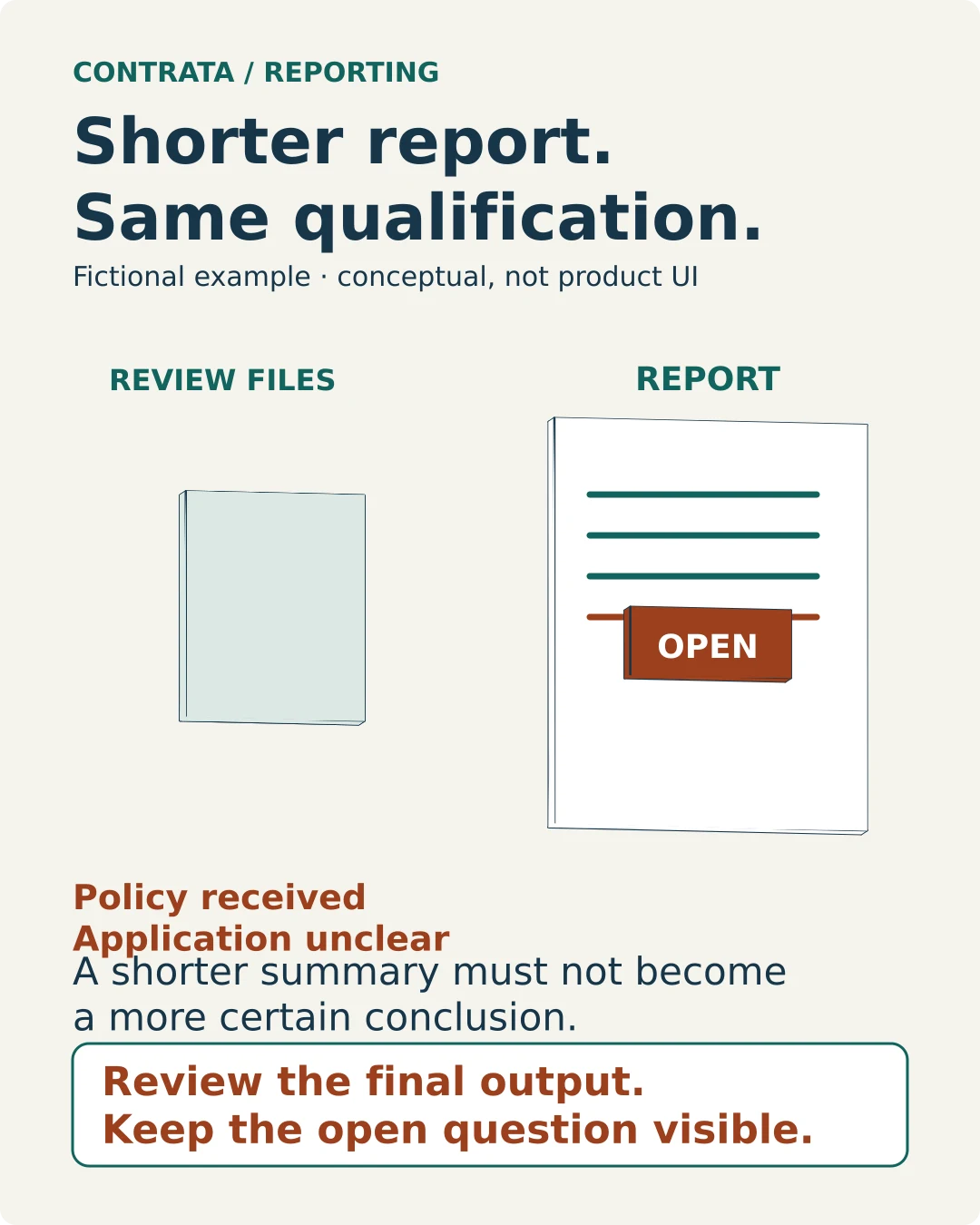
The current review records that the supplier has provided a retention policy. The relationship owner has also asked how that policy applies to historical course-completion records in this particular arrangement. The supplier's reply is still outstanding.
A summary that says “retention reviewed” may be technically true while concealing the unresolved question. A better handover says the policy was received, its application to historical records remains unconfirmed, and the incoming owner needs to obtain and review that clarification.
These are fictional facts used to demonstrate the reporting task. The point is to preserve the distinction between material received, work performed and an issue resolved. A shorter version should not become a more certain version simply because it has fewer words. If the handover includes a risk judgement, preserve the reasoning in a decision record someone else can challenge.
Keep a route back to the underlying review. Use the appropriate record references in the working material, and check that the intended recipient can access what they need through approved channels. Do not assume that exporting a report also transfers access to its supporting evidence.
Review the handover as a separate output
Read the finished draft without relying on your memory of the assessment. Can the incoming owner identify the service, the open question and the next action? Can they tell which statements came from evidence and which represent the team's judgement?
Check that the summary and supporting detail agree. If the detail says a supplier response is pending, the opening paragraph must not imply that the review has resolved the issue. Confirm names, dates and action ownership against the underlying records rather than against an earlier report.
Then inspect the actual presentation. Headings, tables, links and page breaks can change how a reader understands a qualification. A note separated from the conclusion it limits may be missed. Treat the final file or view as something to review, not merely the container for already-reviewed text.
Make circulation deliberate
Before sharing, confirm the appropriate recipients, sensitive detail, report version and person responsible for approval. These are suggested handover controls, not claims about automatic approval or distribution features.
For Harbour Learning, the result is a bounded account of the current review that a new owner can pick up without reconstructing its history. Reporting has done its job when the next person understands the evidence, its limits and the work they now own. The team's review remains the final step before anyone relies on the output.