Article
Assess supplier financial resilience without relying on one score
Assess supplier financial resilience through verified information, service consequences and contingency options. Avoid treating one score as a complete answer.
Contrata editorial team ·
A supplier's revenue has fallen, but the service continues to perform. Another supplier reports strong growth while struggling to retain the specialists who support your platform. Neither headline tells a risk team whether its own service can be sustained.
A financial-resilience review connects reliable financial information with operational consequences. It is not an investment recommendation, a credit rating or a prediction of insolvency.
ACCA's analysis of finance leadership in volatile conditions recommends cooperation between finance and procurement on reliable supplier information, with closer attention to liquidity where circumstances warrant it. That is a useful starting point for a service-focused review, rather than treating a financial headline as a complete risk assessment.
Begin with the service dependence
Identify the arrangement, the capabilities needed to deliver it and the consequence if those capabilities deteriorate. A provider's financial condition matters because it may affect staffing, maintenance, subcontractors, investment or continuity.
Under CPS 230, financial and non-financial risks form part of the assessment before entering or materially modifying a material arrangement. The practical questions below are suggestions for a service-focused review; they are not prescribed financial ratios or regulatory thresholds.
A small contract can still depend on scarce expertise or a difficult-to-replace platform. Conversely, a disappointing financial result does not establish that the relevant service is failing. Keep the connection explicit.
Establish what the information covers
Check the legal entity, reporting period and source before analysing the figures. Group accounts may not explain the resources available to the contracting entity. Old accounts may predate a significant acquisition, refinancing or change in demand.
Where audited financial statements or other reliable public disclosures are available, record their scope and any limitations relevant to your question. For non-public information, use authorised channels and appropriate confidentiality controls.
Separate reported facts from management forecasts and your own assumptions. A supplier's forecast can help frame a discussion, but it should not be presented as an independently verified result.
If financial interpretation exceeds the reviewer's expertise, involve a qualified finance specialist. A checklist should not create false confidence in conclusions about solvency, liquidity or the strength of support from another entity.
Ask how financial pressure could reach the service
Consider the operational pathways that matter to the arrangement:
- Could reduced investment affect maintenance, capacity or security work?
- Does delivery depend on a small group of specialists?
- Are important subcontractors or licences vulnerable to interruption?
- Is the service dependent on continuing support from a parent entity?
- Could a restructuring change the product roadmap or support model?
These are questions to investigate, not assumptions about a provider's conduct. Avoid inferring delayed payments, staffing cuts or control failures from an isolated financial indicator.
APRA's CPG 230 discusses supplier risk and periodic review of material arrangements. A service-focused financial assessment can contribute to that broader oversight without replacing performance and control evidence.

Work a loss-of-contract scenario
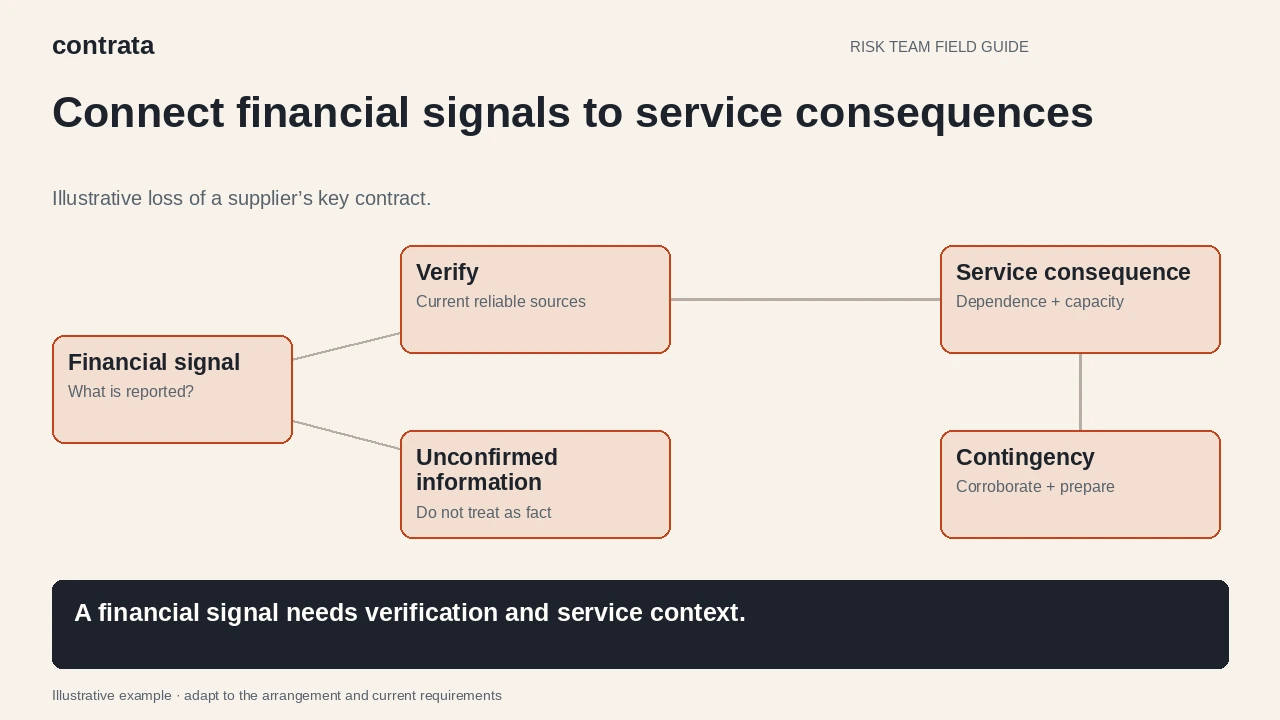
Consider a fictional specialist software provider that announces the loss of a significant customer. Your organisation uses a different service from the same provider. The announcement alone does not show how that service will be affected.
The reviewer checks what the announcement actually says and seeks an explanation of the proposed operating changes. The service owner asks whether the support team, maintenance schedule, recovery arrangements or key subcontractors will change. Finance helps assess the available information and its limitations.
Suppose the provider confirms a planned reorganisation but has not finalised the service model. The review records that uncertainty. It does not state that the provider is insolvent or that service failure is inevitable.
The next action could be a defined follow-up on the new service model, closer monitoring of relevant service indicators and a review of contingency readiness. The appropriate response depends on the organisation's reliance and the evidence, not on the emotional force of the announcement.
Examine assurances of group support
If the provider relies on a parent or related entity, distinguish a general statement of support from an arrangement whose scope and practical effect have been reviewed. Ask the appropriate finance and legal specialists to evaluate what the available documentation establishes.
Do not assume cash reported elsewhere in a group is readily available to the contracting entity. Equally, avoid concluding that it is unavailable without evidence. Record the specific uncertainty and why it matters to the service decision.
A useful assessment states what can be established, what remains unclear and which operational assumptions depend on the answer.
Match monitoring to the concern
Choose signals that could change your conclusion: confirmed service-model changes, relevant reporting updates, missed maintenance commitments or a changed dependency. Record the source and verify concerning claims before escalating them as facts.
Rumours and unverified social posts can prompt a question, but they should not become allegations in a Board pack. Provide decision-makers with the distinction between the signal, corroborated facts and the unresolved issue.
There is no universal score in this article that determines whether to continue or exit. Decisions should consider the full arrangement, available alternatives, legal obligations and the authority required internally.

Test the contingency assumptions
If concern increases, assess what your organisation could actually do. Identify data access, replacement capability, transition resources and dependencies that would affect continuity. Starting this analysis does not require claiming the supplier will fail.
Keep actions proportionate to the evidence and consequence. Unnecessary or poorly timed changes can create their own operational risk.
For a practical example of contingency preparation, the superannuation administrator exit exercise shows how to test transfer and acceptance assumptions; adapt the scenario to your own service and sector.
Use the evidence checklist to preserve the source, interpretation, uncertainty and decision. A defensible review explains how financial information affects the service you rely on, and what further evidence would change the response.