Article
Check the legal entity behind a supplier's brand
Reconcile a supplier's brand, ABN, business-name holder and contract party before signing. Includes a practical identity record and fictional mismatch example.
Contrata editorial team · Published · Prepared on

The proposal carries a familiar brand. The supplier questionnaire names one company, while the contract names another. Both may belong to the same group. That still leaves a basic question unanswered: which entity are you agreeing to buy the service from?
Before signing, reconcile the supplier's names and identifiers against official registers and the proposed contract. Keep the evidence and any explanation together. A register match supports an identity check; it does not approve the supplier or settle the contract's legal effect.
This is a suggested procurement control for lean Australian teams, not legal advice or a regulator-issued checklist.
Start with the proposed contract party
Ask the supplier for the full name and entity type of the proposed contracting party, its ABN and, if it is an Australian company, its ACN. Capture the brand separately. Include the service and contract version so the check cannot be mistaken for approval of every business using that brand.
Do not assume every supplier is a company. A sole trader, partnership or trust arrangement needs different handling. If a trust, trustee capacity, overseas entity or agency arrangement makes the contracting party unclear, ask your legal adviser what evidence and wording are needed. Copying the ABN Lookup name into the agreement is not a substitute for that review.
Use each register for its own question
ABN Lookup provides public ABR information, including entity names, entity type, ABN status and GST registration. An active ABN means its registration is current. It does not prove solvency, service quality, a required licence or the authority of the person negotiating with you.
Search by the supplied identifier, then compare the returned name with the documents. ABN Lookup says its information depends on entities updating their details and is not guaranteed to be accurate, current or complete. Record discrepancies rather than quietly choosing the result that looks closest.
For a registered business name, ASIC's business names register identifies its holder. Free information includes the holder's name, ABN and whether the business-name registration is current. This helps connect a customer-facing name to the person or organisation holding it.
If the proposed party is a company, check ASIC's company and organisation registers. Basic company information is free; more detailed extracts, including officeholder information, are paid. Choose additional evidence because it answers a specific unresolved question, not because every supplier needs the same document pack.
Be careful with old trading names. ABN Lookup's names guidance says legacy trading names are historical references and cannot be relied on for business identity. They are not interchangeable with current registered business names.
Keep a counterparty identity reconciliation record
Use one short record that lets another reviewer repeat the check. Link to the source result or retained extract, with its search date, rather than saving an unexplained screenshot labelled “verified”.
| Field | What to record |
|---|---|
| Arrangement | Service, internal owner and contract version checked. |
| Supplier statements | Brand, proposed legal party, entity type, ABN and relevant company identifier. |
| Independent findings | Register searched, exact returned names and identifiers, relevant status, evidence reference and check time. |
| Comparison | Which fields agree; each mismatch or unresolved relationship. |
| Resolution | Supplier explanation, supporting evidence, reviewer and any specialist advice. |
| Outcome | Identity question resolved or still open, permitted next step and review trigger. |
Keep identity resolution separate from signing approval. Your contract process must also address whether the proposed signatory can act for the party. A name appearing in a register does not, by itself, resolve authority for a particular transaction.
Work through a mismatch instead of explaining it away
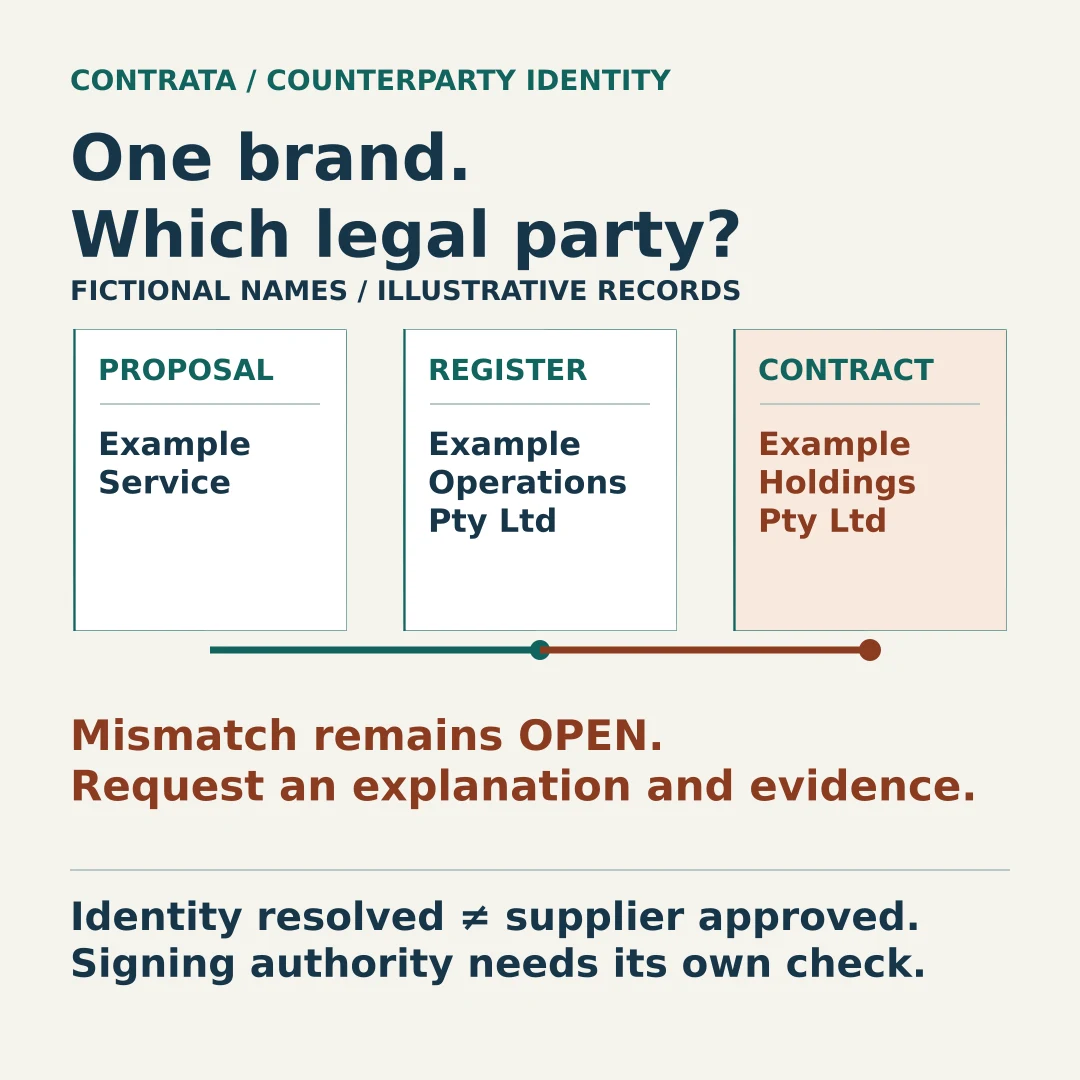
Consider this fictional example. “Example Service” appears on a proposal. The supplied ABN and business-name search point to Example Operations Pty Ltd. The draft contract instead names Example Holdings Pty Ltd. No real registration numbers or businesses are represented.
The reconciliation record should say: “Brand-holder and contract-party mismatch. Supplier explanation requested; identity review remains open.” It should not say “same group, verified”.
Ask which entity will contract, which will deliver the service, and why the documents differ. Request a corrected contract or evidence explaining the intended structure. The targeted evidence follow-up method can help keep that request specific.
Suppose the supplier says the holdings company is the intended party and the operating company delivers the work. That explanation does not settle the review. Check the holdings company's identity separately and have the relevant reviewer assess the contractual responsibilities and supporting evidence. Do not infer a parent guarantee from a shared logo.
Close only the question you checked
ASIC warns that registration does not guarantee a company's quality or represent its endorsement. Keep financial resilience, relevant licensing, security and service capability checks in their own assessments.
When the identity question is resolved, record the accepted contracting party, evidence, reviewer and date. If uncertainty remains, name the next action and decision owner. Use a separate risk decision record where an authorised decision is required; do not turn an unfinished check into approval by changing its status.
Reopen the identity check when the proposed party or identifier changes, including at renewal or after a restructure. Preserve the previous record so the next reviewer can see what changed, rather than only the latest supplier name.