Article
Supplier selection in seven steps: compare evidence before price
A practical supplier-selection workflow for Australian risk teams, with essential requirements, comparable evidence and a worked two-proposal decision.
Contrata editorial team ·

Two suppliers offer the same service. One costs less and has completed every questionnaire field. The other provides stronger evidence that it can deliver the actual workflow. Which proposal should progress?
Set the selection rules before comparing the offers. Decide which requirements a proposal must satisfy, what evidence will demonstrate them and which preferences can reasonably be traded against price. Otherwise, an attractive total can hide an unresolved requirement.
The seven steps below are an original practical workflow for supplier selection. They are not a universal procurement standard or an APRA-prescribed sequence. The CIPS Procurement and Supply Cycle has 13 steps across a broader lifecycle, including specification, market analysis, evaluation, contracting and ongoing management.
What are the 7 steps of the supplier selection process?
For a service-provider decision, use these seven steps: define the service need; agree selection rules; build a credible shortlist; collect comparable evidence; evaluate the proposals; obtain the authorised decision; and hand the agreed service into operations. Return to an earlier step when evidence changes the requirements or available options.
1. Define the service and the alternatives
Write a short description of the outcome, users, information, volumes and operating conditions. Identify work your organisation will retain. Include the consequences of interruption and any dependencies on other suppliers.
Consider whether buying the service is the right option. An internal solution, a narrower scope or a change to an existing arrangement may be feasible. Record why alternatives are included or excluded; do not create a shortlist solely to validate a preferred supplier.
For an APRA-regulated entity, assess the provider and proposed arrangement under your materiality policy. The provider-versus-arrangement guide explains why those are related but separate decisions. Team size does not determine regulatory classification.
2. Agree essential requirements and comparison rules
Separate conditions that must be satisfied from preferences used to compare acceptable offers. For each essential condition, name the evidence required and who will judge it. Specify whether it must be demonstrated before selection, signing or service commencement.
Agree the evaluation approach before proposals arrive. Include who can clarify a response, how changes will be communicated consistently and who can approve a change to the requirements. A commercial deadline should not silently change an essential condition into a preference.
For material arrangements, CPS 230 requires appropriate due diligence before entry or material modification, including an appropriate selection process, assessment of ongoing delivery capability and assessment of financial and non-financial risks. Apply the actual standard and relevant provisions to the arrangement; a completed selection worksheet does not establish compliance.
3. Build a shortlist that can meet the need
Use proportionate early checks to establish whether a supplier can plausibly deliver the proposed service. Confirm the contracting entity, delivery model, relevant experience, capacity and major dependencies. Avoid asking every potential supplier for a full assessment before basic suitability is known.
Check whether apparently different proposals depend on the same underlying provider. Switching a direct supplier may leave a shared hosting, dispatch or support dependency unchanged.
APRA's CPG 230 identifies retained in-house capability, country or region risk, supplier risk, concentration risk and reputational risk as considerations when selecting a prospective provider of material arrangements. CPG 230 is guidance and does not itself create enforceable requirements.
4. Collect comparable evidence
Give shortlisted suppliers the same service description and essential criteria. Request evidence for the proposed service, entity and delivery locations. Where responses differ, seek a targeted clarification rather than assuming an unanswered question means the capability is absent.
Use the third party risk assessment questionnaire to structure service-specific questions and evidence requests. It supports this selection step; its completion does not choose the supplier.
Record the scope and limits of each item. A group policy, a planned capability and a completed test answer different questions. Mark a requirement as unresolved when the evidence does not yet support a conclusion.
5. Compare eligible proposals on consistent assumptions
First identify whether each essential requirement is supported, contradicted or still unproven. Then compare the remaining trade-offs using the agreed criteria. CIPS recommends evaluation against predefined award criteria and consideration of whole-life costs. Its cycle also distinguishes requirements from preferences when developing specifications.
Compare costs over a common scope and period. Include relevant implementation, integration, internal oversight, transition and exit work. State assumptions about volumes and retained staff effort. A cheaper quote may exclude work included in the other proposal.
If the organisation uses weighted scores, preserve the findings behind them. A favourable total cannot supply missing evidence or authorise departure from a mandatory obligation. Any permitted exception to an internal requirement needs its own decision under the applicable policy.
6. Obtain a decision within the right authority
Present the options, supporting evidence, unresolved requirements and consequences of delay. Distinguish the team's recommendation from the decision made by the authorised person or committee.
The supplier-risk ownership guide helps allocate work across service owners, procurement, specialists and risk. Use the decision-record guide for the detailed rationale rather than copying an entire approval process into the selection sheet.
Record what the decision permits. Permission to continue negotiations is different from permission to sign or commence service. Identify any conditions that must be met before the next commitment.
7. Hand the selected service into operations
Transfer the agreed scope, evidence limits, conditions, responsibilities and review triggers to the operational owner. Align these with the contract and implementation plan. Do not leave the selection assumptions only in a procurement folder.
Choose monitoring that can detect changes to those assumptions: a delivery-location change, a different subcontractor, a missed implementation condition or an incident affecting a relevant dependency. Preserve the exit requirements used in the comparison so that someone can later check whether they remain workable.
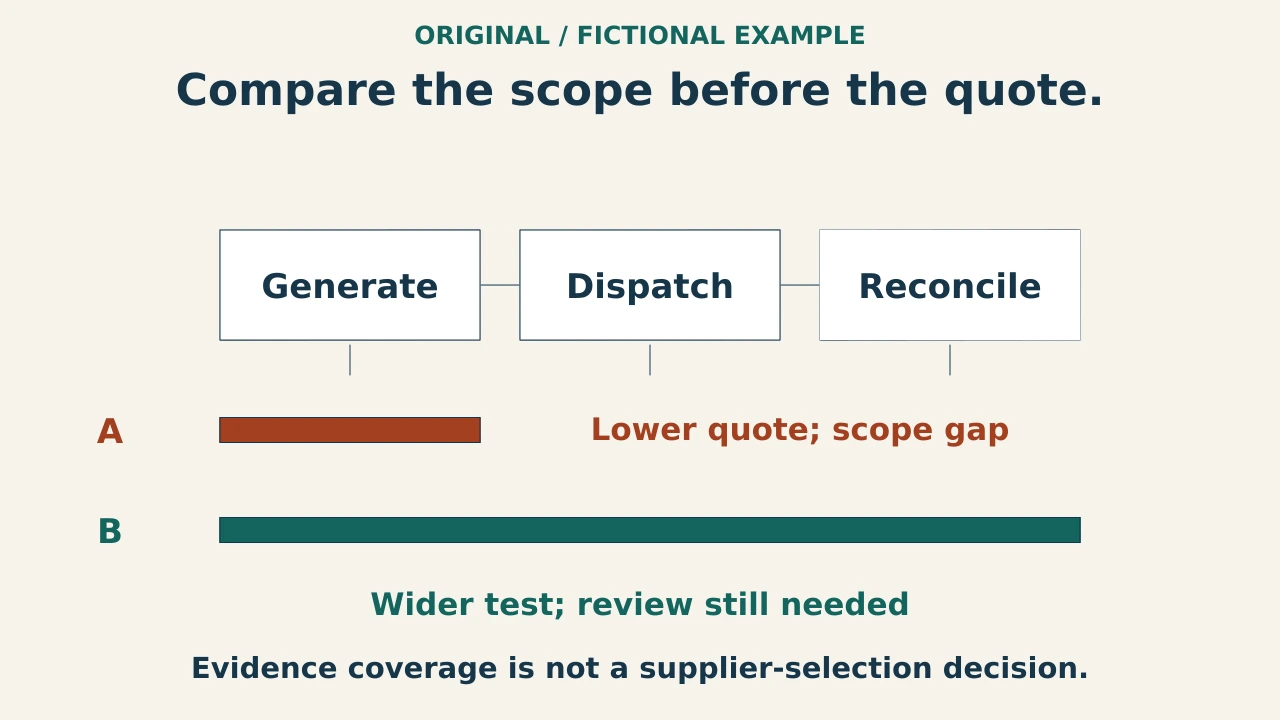
Worked example: the lower quote leaves an essential question open
This fictional super fund is selecting a member-document distribution service. It will retain responsibility for approving document content. The supplier will generate documents, hand them to the agreed dispatch channel and return delivery-status information for reconciliation. Neither supplier represents a real company or customer.
The fund has set an internal essential requirement: demonstrate recovery of that complete workflow before a final selection decision. The requirement is an assumption for this example, not a universal legal deadline or a conclusion that every document-distribution arrangement is material.
| Comparison point | Proposal A | Proposal B |
|---|---|---|
| Quoted price for the agreed base scope | Lower | Higher |
| Recovery evidence received | Exercise covers document generation; dispatch handover and status reconciliation excluded | Exercise covers the proposed end-to-end workflow; findings supplied for review |
| Essential recovery requirement | Unproven on the current evidence | Relevant evidence received; reviewer must assess results and outstanding findings |
| Cost clarification still needed | Price and retained effort for reconciliation support | Implementation and transition assumptions |
| Next selection action | Seek scoped evidence; keep requirement open | Review findings and assumptions; keep final decision with the authorised person |
The team cannot conclude that A is incapable of recovery. It can conclude that A's evidence does not yet demonstrate the agreed requirement. Nor does B's broader test automatically make B the winner: the reviewer still needs to assess its results, and other essential requirements remain in scope.
If A supplies adequate evidence, the comparison can progress. If neither proposal meets the essential conditions, the options include further evidence, a revised service design or a different sourcing approach. Any change to the original requirement needs a recorded rationale and the appropriate authority; a lower price does not resolve the evidence gap.
What are the 5 essential factors when dealing with suppliers?
For this service-selection task, use five factors as an original review aid: service fit, delivery capability, risk and resilience, whole-life value, and relationship and exit arrangements. They are not a recognised universal five-factor standard, and they do not replace specialist or arrangement-specific requirements.
| Factor | A question the reviewer should be able to answer |
|---|---|
| Service fit | Does the proposal cover the required outcome, boundaries and retained responsibilities? |
| Delivery capability | Can the proposed people, systems and capacity deliver the service under the expected conditions? |
| Risk and resilience | What could interrupt or compromise delivery, what evidence supports the controls, and what remains unknown? |
| Whole-life value | What will the arrangement cost across implementation, operation, oversight and exit on comparable assumptions? |
| Relationship and exit arrangements | Can both parties manage performance, changes, disputes and a workable transition? |
Use the factors to check the completeness of the comparison. In the fictional fund's case, the open recovery question belongs under risk and resilience; the omitted reconciliation effort belongs under whole-life value. Keeping those findings separate shows what must change before the team can make a defensible recommendation.