Article
Work backwards from your supplier contract notice deadline
Build a supplier notice worksheet covering service, receipt, time zones and decision buffers before a renewal or expiry removes your options.
Contrata editorial team · Published · Prepared on

A supplier contract expires in three months. The service owner puts a renewal discussion in next month's calendar. That may already be too late if the agreement requires notice well before expiry.
For a lean third-party risk team, the useful starting point is the last date for taking the intended contractual action. Work backwards from that date to the decision, evidence and approvals needed to act. Keep the expiry date visible, but give the notice deadline its own owner.
This is a suggested planning method, not legal advice or a prescribed regulatory process. It does not establish whether any particular notice is valid. Ask the legal reviewer to resolve contractual interpretation before relying on the dates.
Identify the action before calculating the date
Non-renewal, termination for convenience and termination for breach are different decisions. Do not copy a deadline from one clause into a task governed by another.
Start with the signed agreement, relevant schedules, amendments and incorporated terms. Identify the exact service and contracting entity. Ask the legal reviewer which provisions govern the proposed action and how conflicting documents should be read.
business.gov.au's guidance on ending a contract recommends checking whether a convenience clause exists, how much notice is required and what becomes payable. It also recommends considering legal advice before acting. An expiry reminder alone cannot answer those questions.
For a wider review of how contractual rights translate into operating procedures, use the service-provider contract review guide. The narrower job here is to make one notice process executable.
Check the whole notice route
Ask the reviewer to confirm how the following details interact in this agreement:
- The recipient: legal entity, named role, address and any required copies.
- The permitted service method: for example, whether email is allowed and which address applies.
- The timing rule: whether the relevant event is sending, delivery, receipt or deemed receipt.
- The calendar: calendar days or defined business days, including applicable public holidays and any rule for a deadline falling on a non-business day.
- The clock: relevant time zone, time-of-day cut-off and treatment of messages received outside the specified hours.
- The notice itself: required content, authorised sender or signatory and supporting documents.
These are questions to check, not universal rules. Do not assume that an account manager's usual email address is the contractual notice address, or that a sent-message timestamp establishes effective service. Equally, do not invent a deemed-receipt delay when the agreement does not provide one.
Where the wording is unclear, record the question and assign it for review. A spreadsheet formula should not quietly decide a legal interpretation.
Build a short deadline worksheet
Keep the worksheet beside the applicable contract version. This is an original planning aid, not a model notice or legal checklist.
| Field | What to record |
|---|---|
| Intended action | Service, contracting entities and proposed non-renewal or other action |
| Governing provisions | Document versions, clause references and unresolved interpretations |
| Reviewed deadline | Date, time, time zone and reviewer-confirmed calculation basis |
| Service route | Permitted method, recipient, required copies and receipt rules |
| Planned service date | Earlier operational target and reason for the buffer |
| Internal decision date | Approver, evidence needed and time allowed to prepare the notice |
| Completion evidence | Approved notice, dispatch/delivery records and receipt assessment |
| Escalation | Backup owner and action if approval or service cannot be completed |
Set separate reminders for the internal decision, planned service and reviewed deadline. Put them in a shared workflow with a backup owner, rather than relying only on one person's calendar.
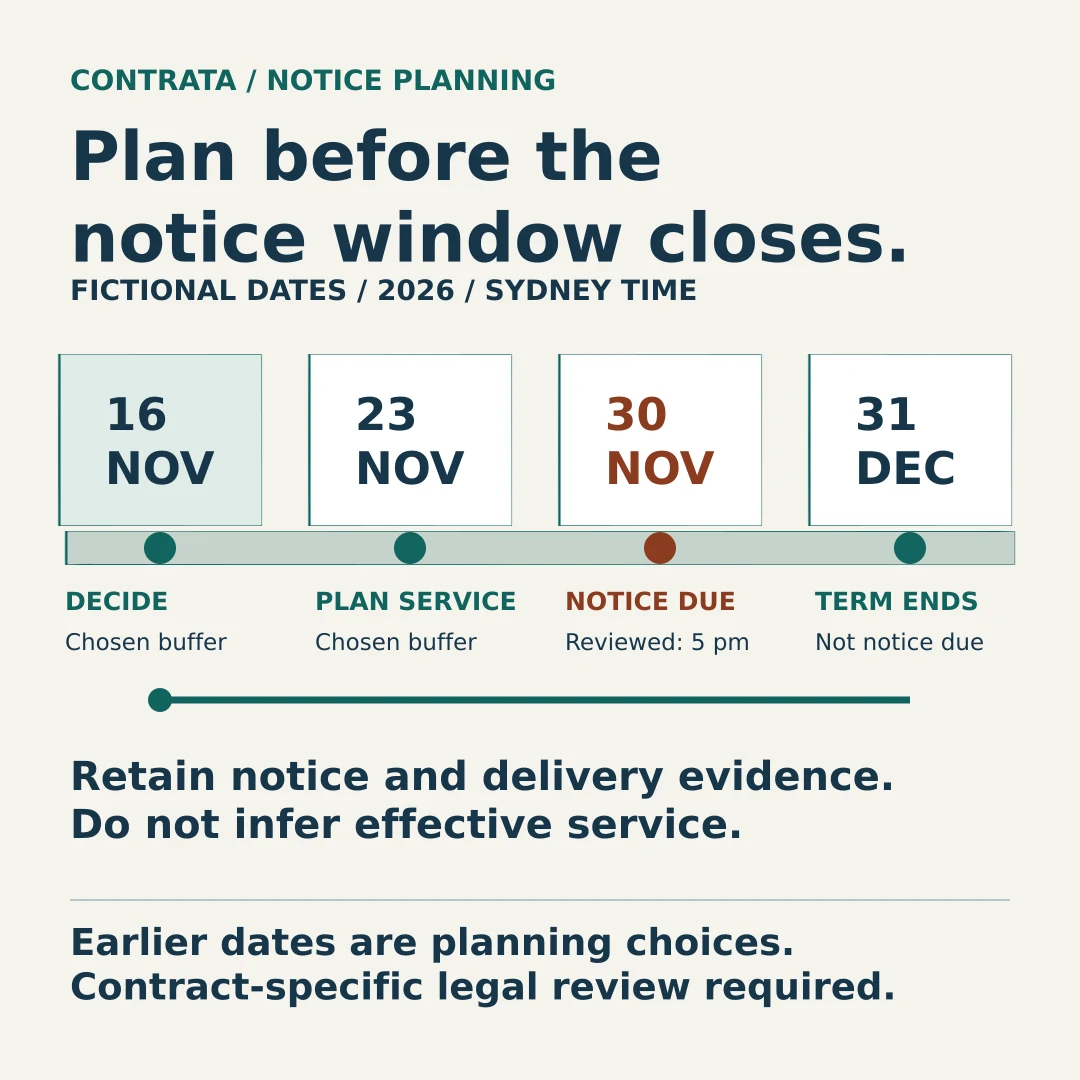
A fictional decision buffer
Banksia Services is an invented Australian organisation reviewing a software subscription. For this example only, assume its legal reviewer has confirmed a non-renewal notice deadline of 5 pm Sydney time on 30 November 2026, with the term ending on 31 December 2026. These dates are assumptions, not the result of a generic notice-period formula.
Banksia chooses 23 November as its planned service date and 16 November as its internal decision date. Those earlier dates are discretionary planning buffers, not additional contractual requirements. The team checks whether the permitted service method and receipt provisions leave enough time to investigate a delivery problem.
By 16 November, the approver needs the service owner's recommendation, replacement-readiness evidence, cost implications and unresolved risks. If the replacement remains untested, that uncertainty belongs in the decision paper. The administrator exit tabletop guide illustrates how to examine transition handoffs, although its superannuation example needs adapting to Banksia's service.
An account manager's acknowledgement is retained as correspondence. The legal reviewer still assesses completion against the agreed notice requirements. Banksia closes the task only when the responsible owner has recorded that assessment and the supporting evidence.
Escalate uncertainty before the buffer disappears
If a deadline may have passed, preserve the records and seek advice promptly. Do not mark the notice effective merely because the supplier has not objected.
The ACCC's contract guidance explains unfair-contract-term protections and that only a court can decide whether a term is unfair. Concerns about a renewal clause need proper assessment; they are not a reason to assume the notice process can be ignored. The audience for this worksheet does not determine eligibility for those protections.
Start with the next important supplier renewal. Confirm its notice route, record the reviewed deadline and set the internal decision date while there is still time to resolve the unanswered questions.