Article
Keep supplier evidence connected to the assessment
Connect proposed assessment answers to their sources, retain evidence limits and keep the final judgement with your reviewer.
Contrata editorial team · Published · Prepared on

A supplier sends a service description. A colleague adds a questionnaire response. Someone else has an email explaining that the service description does not cover support access. By the time an assessment answer is drafted, the qualification can be harder to find than the reassuring headline.
The useful question is not simply whether the documents have been collected. It is whether the reviewer can connect the proposed answer to the evidence that supports it, and see what that evidence leaves unresolved.
Contrata’s assessment workflow is designed around that connection. Its public product description brings uploaded evidence, drafted answers and human review together. The practical value is in keeping the material for a review together, not removing the need to examine it.
From a document collection to a reviewable answer
A folder can hold the relevant files without explaining why any one of them matters. An assessment adds a question: what are we trying to establish about this provider and this service?
Contrata describes an assessment workflow in which teams draft answers from uploaded evidence, inspect the sources and route the response for human review. Its published product overview also describes original files and supplier messages linked to the relevant assessment.
That is the product capability discussed here. It is not a claim that every uploaded document is complete, that an AI draft is correct, or that a source link establishes a control’s effectiveness. Your reviewer still needs to read the relevant material and decide what it supports.
For a small team, a useful starting point is one assessment question with a real decision behind it. Avoid a demonstration that stops at a polished paragraph. Follow the paragraph back to the underlying material.
A fictional example: two answers to different questions
Imagine an Australian organisation reviewing a document-processing provider. The assessment asks where people may access the organisation’s documents, not just where the documents are stored.
The provider supplies a service description confirming Australian hosting. A separate response explains that an overseas support team may assist with incidents, but does not establish whether those people can access customer documents.
“Data is hosted in Australia” answers the storage question. It does not settle the access question. Keeping the service description and supplier response connected to the assessment helps the reviewer identify exactly what remains unknown, rather than confusing one answer with the other.
This is an illustrative review scenario, not a customer case or a claim that Contrata has processed these documents. It does not establish that overseas access occurs, or that any particular access arrangement is acceptable or prohibited.
The next step is a targeted supplier follow-up: can support staff access the documents, from where, and under what conditions? The question follows from the evidence already received. It need not restart the whole questionnaire.
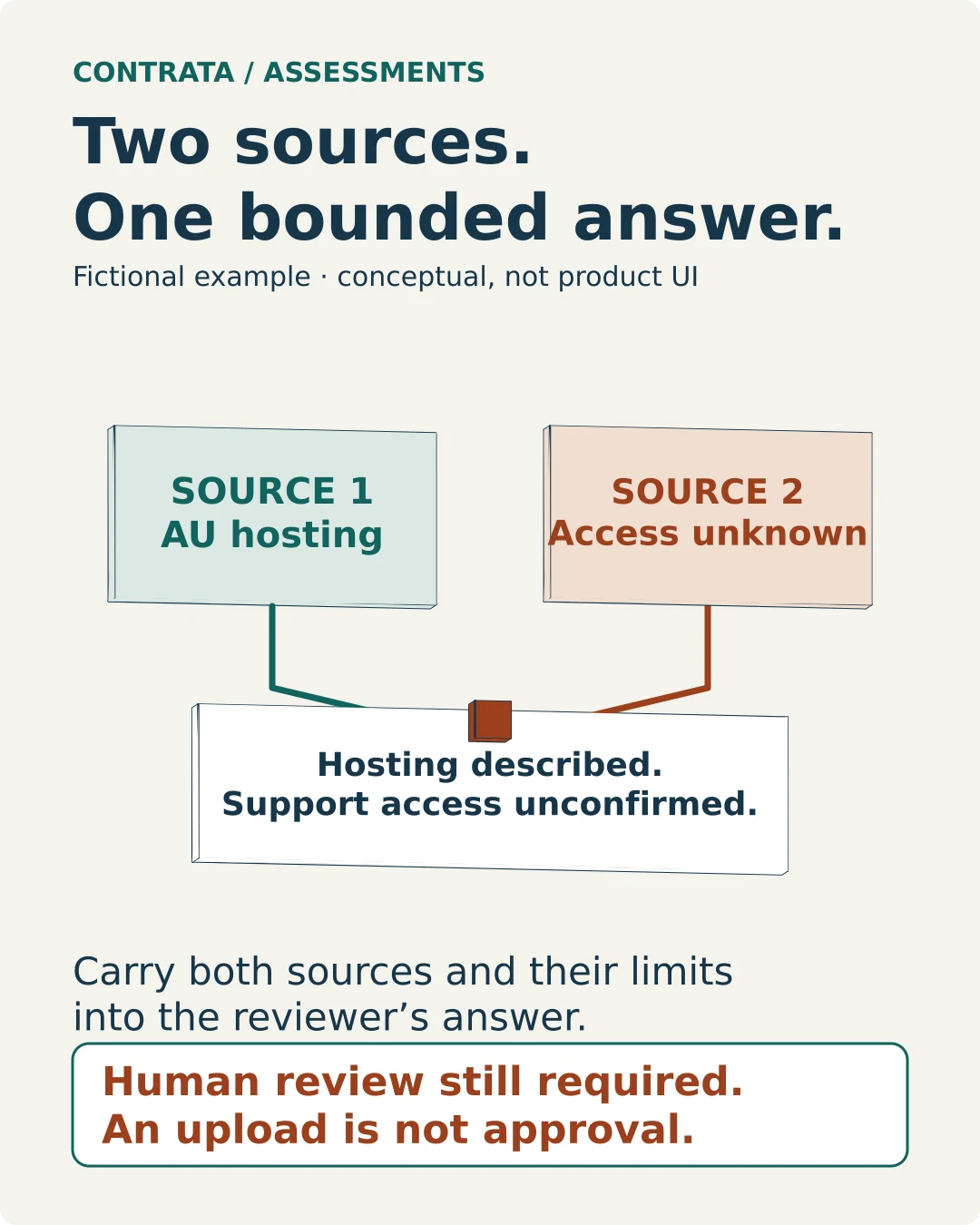
Original conceptual illustration. Fictional documents and workflow, not product UI. An upload is not an approval.
Keep collection and judgement separate
Contrata’s public description includes supplier requests, replies, attachments and follow-up questions alongside assessment work. These activities help organise the evidence-gathering process. They do not decide whether the evidence is sufficient for your organisation’s proposed use of the service. Product overview.
In the fictional example, the service owner can explain which documents the provider handles. A technical or privacy specialist can help establish the significance of any support access. The authorised decision-maker determines what happens next under the organisation’s own governance.
A request marked complete and a risk decision are different things. Preserve that distinction when explaining the outcome to colleagues. For a fuller check of generated answers, see human review of AI-assisted supplier assessments. For guidance on recording the reasoning, see writing a third-party risk decision someone else can challenge.
Bring these four checks to a demonstration
Use a sanitised example that you are authorised to share. Ask the demonstrator to work through these questions rather than relying on a generic walkthrough:
What supports this sentence? Inspect the source behind a drafted answer and confirm that its meaning has been retained.
What falls outside the evidence? Check whether the document covers your service, period and review question. Identify any limit that the answer should preserve.
What happens when sources disagree? Present a qualification or conflicting response and examine the proposed answer and the human review needed.
What remains for our team to decide? Separate the evidence-gathering step from the conclusion and any authorised action.
These are suggested evaluation questions, not a promise of specific interface controls, integrations, access permissions or automatic outcomes. Confirm the workflow and configuration your organisation would actually use.
Start with one evidence trail
A useful demonstration ends with a reviewer able to explain what is known, which source supports it and what still needs attention. That is a more meaningful test than how quickly an answer appears.
Explore Contrata with one real assessment challenge in mind. Keep the test small enough to inspect carefully, and keep the final judgement with the people responsible for the provider relationship.