Article
Review supplier insurance beyond the certificate of currency
Check supplier insurance evidence against the entity, service, policy period, limits and exclusions, then route unresolved coverage questions to specialists.
Contrata editorial team · Published · Prepared on

A supplier's certificate of currency is evidence about an insurance policy, not a guarantee that a loss arising from your service will be covered. Before closing the review, identify what the certificate establishes and which questions need the underlying documents or specialist advice.
Defence's guidance on certificates of currency explains the distinction: a certificate provides evidence of a policy being in force when issued, but does not give its full terms, conditions and exclusions. Defence publishes this for its procurement staff; it is not a universal rule requiring every Australian supplier to provide the same documents.
This article suggests an evidence-review process, not insurance, financial or legal advice. It does not recommend a policy, minimum limit or decision about whether a claim would succeed.
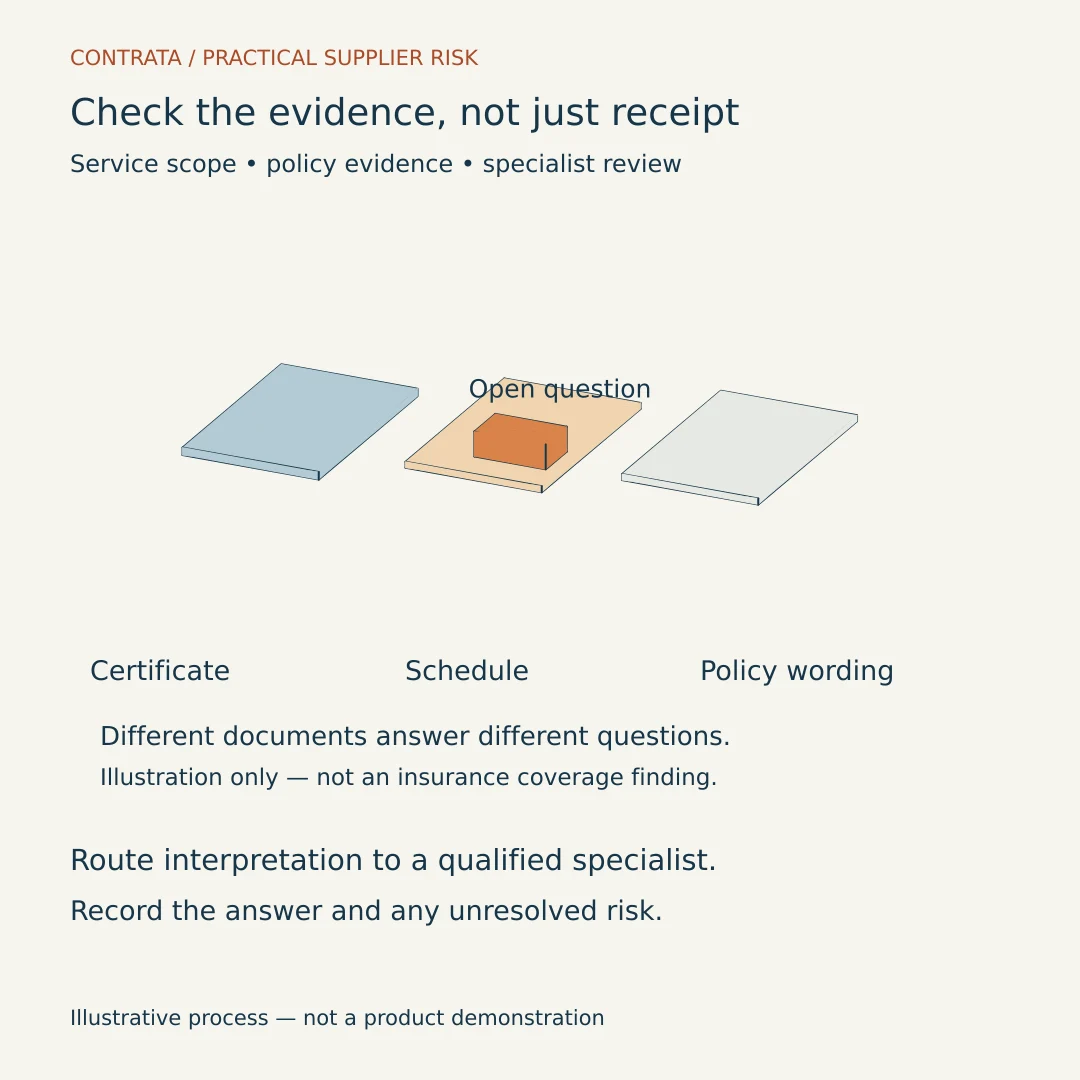
Define the insurance question before requesting documents
Start with the service description and the insurance requirements actually agreed in the contract. Ask the service owner what the supplier does, where the work happens and which activities have changed. Record the document versions being compared.
Keep three questions separate: what the supplier agreed to maintain, what the evidence says it holds, and whether that arrangement is suitable for the exposure. A procurement reviewer can organise the first two without claiming authority to settle the third. Unclear obligations belong with legal counsel; questions about insurance suitability and policy response belong with an appropriately qualified insurance specialist.
For example, a questionnaire entry saying “professional indemnity held” does not explain how the insured activities relate to a new implementation service. The next request should identify that service, rather than simply asking for another certificate.
Compare five parts of the evidence
Use this original worksheet to record questions, not to produce an automatic pass. It is deliberately shorter than a full insurance review.
| Review area | Record and compare | Question if unclear |
|---|---|---|
| Insured entity | Contract party and entity named in the evidence | What establishes that the contracting entity is included? |
| Service | Actual activities, locations and the stated insured business or services | Does the description include the work we receive? |
| Period | Issue date, policy dates and next renewal | What evidence will address the next service period? |
| Limit | Stated amount, currency and relevant qualifications | How do any sub-limits or excesses affect the requirement being reviewed? |
| Exclusions and changes | Relevant restrictions, extensions and policy amendments | Which documents or written clarification resolve this question? |
Western Australia's July 2025 procurement insurance guideline identifies these kinds of certificate details and warns that exclusions are not always shown. Its instructions apply to WA State agencies; the worksheet above is a suggested aid for other teams, not an extension of those instructions.
A large headline limit also needs interpretation. Defence's guidance notes that a certificate does not establish that earlier claims have left the stated limit untouched. Refer consequential questions about available cover to a specialist rather than treating the printed amount as money reserved for your contract.
Ask for an answer to the gap
An evidence request should name the uncertainty and why it matters. Relevant policy wording, the schedule, endorsements or written clarification from the insurer or broker may help, depending on the question. Follow contractual access rights and confidentiality arrangements; do not demand an entire insurance programme by default.
The Australian Government's business insurance guidance recommends understanding definitions, exclusions, excesses and policy conditions, and getting professional help where necessary. Receiving more pages does not remove the need for interpretation.
The National Insurance Brokers Association's explanation of a broker's role is useful when deciding who should address product features, exclusions and renewal questions. Establish whose adviser is responding and what their response actually confirms. Keep legal interpretation of contractual obligations with the legal reviewer.
Fictional example: an added implementation service
A fictional software supplier has begun configuring customer workflows as well as providing access to its platform. The contract change adds this work, but the insurance evidence uses a broad business description. The certificate's dates are current.
The reviewer records the implementation activities and asks the supplier to obtain clarification about how they relate to the policy. The reviewer does not conclude that configuration is covered, or excluded, from the description alone.
Suppose the supplier responds with the same certificate. The file-receipt task can be complete while the coverage question remains open. The service owner receives a short note identifying the unanswered question, its specialist owner and the decision that depends on it. Any interim operating restriction or acceptance of uncertainty needs the organisation's authorised decision-maker, not the person uploading the file.
Keep the conclusion separate from the renewal reminder
Record the documents reviewed, questions resolved, remaining uncertainty, responsible owner and next review trigger. Set a renewal follow-up with enough time for the supplier to respond and for the organisation to assess changes. A new file should not silently overwrite the reasoning behind the earlier decision.
Business.gov.au recommends reviewing insurance when activities change and before renewal. For supplier oversight, a changed service or entity can therefore prompt a fresh evidence question rather than waiting for the expiry reminder.
Keep other assessments distinct. An insurance record does not replace a review of supplier assurance reports or an assessment of financial resilience and service continuity.
Finish with a precise status: certificate received, specified details checked, and any unresolved insurance question assigned to the right specialist. Do not convert receipt of the certificate into a conclusion that the service is fully covered.