Article
Build a supplier relationship management framework around a shared plan
Five practical components for managing an ongoing supplier relationship, with a super fund example showing obligations on both sides of a joint milestone.
Contrata editorial team ·

A supplier review ends with a promise to improve processing before the next busy period. The supplier needs an agreed input file from your team. Your team expects the supplier to demonstrate that its processing changes work. Neither dependency appears in the meeting actions.
The next meeting may repeat the same discussion. A useful supplier relationship management framework makes the shared objective, each party's contribution and the evidence of progress clear enough to act on between meetings.
Here, SRM means supplier relationship management. It concerns the ongoing working relationship after selection. The supplier-selection guide covers the earlier decision between proposals; the SRM audit guide explains why the acronym needs a defined scope in an audit brief.
What are the 5 key components of the SRM framework?
For an ongoing service relationship, a practical five-component structure is: relationship priority, shared outcomes, working responsibilities, evidence-based reviews, and improvement and change. This is an original editorial structure to adapt, not a universal five-part SRM standard or an APRA-prescribed framework.
Established guidance can organise the work differently. New Zealand Government Procurement's SRM guide uses four phases: preparation, planning, implementation and monitoring. It includes joint business planning and considers satisfaction on both sides of the relationship. It is New Zealand procurement guidance, not an Australian regulatory requirement.
1. Set the relationship priority
Decide why this supplier needs a shared relationship plan. Identify the service outcomes that depend on joint work, the changes approaching and the effort each organisation can reasonably commit.
For a routine purchase with straightforward delivery, a clear contract contact and proportionate performance follow-up may be sufficient. A difficult-to-replace service facing a substantial change may need closer coordination. Record the reason for that difference instead of assigning the same meeting schedule to every supplier.
Relationship priority is separate from regulatory materiality and risk severity. A collaborative relationship label does not settle either assessment. Use your organisation's criteria and the provider-versus-arrangement guide where that distinction needs work.
2. Agree the outcome both parties are working towards
Write the intended improvement in terms of the service your organisation uses. “Strengthen the partnership” gives neither team a completion test. “Rehearse the revised contribution-file process before the peak-cycle change” identifies work they can plan.
Separate the service obligation already in the agreement from a proposed improvement. State which contract, service schedule or approved change defines the obligation. A relationship plan should not silently amend service levels, waive a right or commit either party to new work.
CIPS's supplier-management guidance recognises that better performance can require changes by the buying organisation as well as the supplier. Ask what your own team must contribute before treating the improvement as solely a supplier action.
3. Name the working responsibilities and decision boundaries
For each joint milestone, identify the deliverable from each party, its owner, the dependency and the person who will review the result. Include how the teams will resolve a missing input or disagreement before it affects the service.
Keep working coordination separate from authority. An account manager may coordinate an exercise without being able to change contractual commitments. A service owner may recommend a proposal without holding authority to accept its remaining risk. The small-team ownership guide covers those internal delegations in more detail.
Specify what information each participant needs and use approved access and sharing arrangements. A joint plan does not justify sending customer records to everyone attending the supplier meeting.
4. Review evidence of the joint outcome
Agree how each side will show progress. Keep a supplier's delivery measure where it is useful, and add the buyer's corresponding acceptance check when the outcome depends on both organisations.
For example, delivering a revised file format establishes that a file was supplied. It does not establish that the receiving process can use it. An exercise result should identify which version and workflow were tested, what failed and what remains unresolved.
Use meetings to explain those results and decide the next action. A positive relationship survey or a completed meeting cannot substitute for evidence about the service. The ongoing monitoring guide covers operational signals and escalation separately.
5. Manage improvement and change as defined work
Turn an improvement idea into a bounded proposal: expected benefit, work required from both sides, new dependencies, cost or contract implications, and the evidence needed before relying on it.
Give the proposal a review point. If the benefit is uncertain, a limited exercise may answer the question before a larger commitment. If a change fails its agreed check, record that result and determine the next step through the applicable governance process.
Keep supplier underperformance, internal delay and unresolved disagreement visible as different issues. They may require different responses. Preserve the options available under the agreement and the organisation's risk process rather than assuming that a good working relationship makes escalation or exit unnecessary.
Worked example: two obligations, one rehearsal milestone
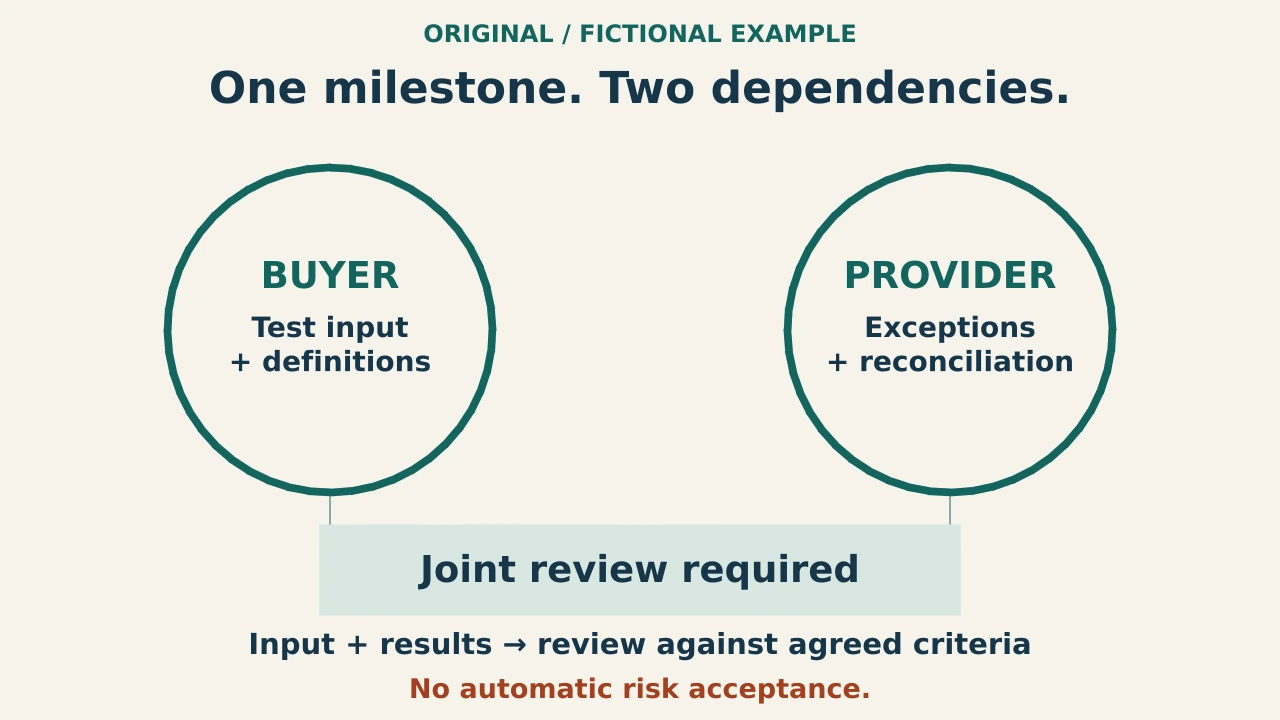
This fictional super fund has an existing administration provider. Both teams want to rehearse revised contribution-file processing before a peak-cycle change. The fund retains responsibility for preparing the agreed input; the provider must demonstrate how its proposed mapping handles that input. The scenario is invented and does not describe a customer or an industry-wide requirement.
The first action list says “Provider to confirm readiness”. It omits the fund's input dependency and leaves readiness undefined. The teams replace it with a joint milestone:
Review a processing rehearsal against agreed acceptance criteria before the proposed peak-cycle change proceeds.
| Party | Responsibility | Evidence for the joint review |
|---|---|---|
| Fund operations team | Supply the agreed test contribution input file and field definitions through the approved test route. | A versioned input manifest and confirmation that the file matches the agreed test scope. |
| Administration provider | Rehearse processing and mapping using that input, then return exception and reconciliation results. | A rehearsal record identifying the input version, processing outcome, exceptions and reconciliation results. |
| Both service teams | Review the result against agreed criteria and identify anything that prevents progression. | A recorded review outcome, unresolved findings and the next action or escalation. |
Suppose the fund supplies a file but omits a required field definition. The provider can acknowledge receipt while recording that the rehearsal is blocked. The fund's task remains incomplete against its agreed deliverable; marking the provider overdue would conceal the dependency.
After the definition arrives, the provider runs the rehearsal. Its results show that an exception record cannot yet be reconciled. The input obligation may now be complete, while the joint milestone remains open. The teams record the unresolved exception and assign the next investigation without claiming that the process is ready.
The result could support a revised rehearsal, a changed proposal or escalation before the commitment point. Completing the meeting, supplying the file or demonstrating one part of processing does not itself authorise the change or accept the remaining exposure.

Keep the relationship plan alongside the risk obligations
For APRA-regulated entities, CPS 230 requires monitoring and senior-management reporting on material arrangements commensurate with the nature and usage of the service. Its regular assessment includes service-agreement performance, relevant control effectiveness and both parties' compliance with the agreement. Those requirements are distinct from this article's suggested relationship plan.
Use the third party risk assessment questionnaire when a change requires focused evidence questions. Carry any decision on the remaining exposure into the decision record. A shared improvement plan helps organise the work; the organisation retains responsibility for its risk decisions and compliance.
For the next supplier review, choose one promised improvement and identify the input required from each party. Record what joint result would demonstrate progress, and what will happen if either input or the result is missing.