Article
What is supplier risk? Categories and examples for lean risk teams
Define supplier risk around the service and objective, compare category models, and use five fictional insurer and super-fund examples to frame a review.
Contrata editorial team · Published · Prepared on

A supplier can meet its own contractual target while leaving your organisation unable to finish an important task. A platform may be available but produce unusable records. A supplier may be financially stable while relying on the same vulnerable infrastructure as another provider.
Calling each supplier “high risk” does little to explain those differences. Start with the service, what could go wrong and the effect on the people or objective you are responsible for.
What is supplier risk?
In this guide, supplier risk means uncertainty about a supplier relationship that could affect your organisation’s objectives. The relationship includes choosing, onboarding, using, changing and leaving the service. This article concentrates on adverse outcomes; risk management more broadly also considers opportunities.
For an insurer, the objective might be timely handling of claims. For a super fund, it might be accurate administration of member records. The risk concerns what happens to that objective, not merely whether the provider has a certificate or a recognised name.
For APRA-regulated entities, CPS 230 provides requirements for operational risk, critical operations and service-provider arrangements. It is relevant context for these examples, not a universal definition of every kind of supplier risk or a checklist that applies identically to every organisation.
A useful starting sentence is: because of a stated condition, an event could happen, affecting an identified objective. For example: because the claims provider and its fallback use the same specialist team, an absence could interrupt urgent-case handling at both locations. Evidence is then needed to assess that scenario.
What are supplier risks?
Supplier risks are the individual exposures within a relationship. One provider can create several, and one event can affect several objectives. A broad category helps route the review; it does not replace the scenario, evidence or decision.
Separate these terms:
| Term | Meaning in this guide | Fictional example |
|---|---|---|
| Category | A grouping used by your framework | Service continuity |
| Risk scenario | A possible event and its effect in context | Loss of a supplier team delays urgent claims |
| Incident | Something that has happened | The team becomes unavailable |
| Control | An action or arrangement addressing the scenario | An independently staffed fallback |
| Assessment | Judgement based on the method and available evidence | Whether that fallback works for the relevant cases |
The inherent and residual risk guide explains how to assess exposure before and after evidenced controls. That is a later task than choosing a category.
What are the 7 types of risks?
The question needs a named framework before a definitive list can be given. The seven areas below are this guide’s practical review lenses, not APRA’s prescribed seven supplier-risk categories. Map them to your approved definitions rather than creating a competing register.
| Review lens | Question to investigate |
|---|---|
| Delivery and continuity | Can the service perform the work needed during ordinary conditions and disruption? |
| Information security and privacy | Could access, disclosure, loss or misuse of information affect the organisation or its customers? |
| Financial and commercial viability | Could the provider’s position undermine continued delivery or an orderly transition? |
| Legal and compliance | Are the proposed arrangement and its actual delivery consistent with applicable obligations? |
| People and conduct | Could staff dependency, inappropriate behaviour or weak supervision affect outcomes? |
| Dependency and concentration | Could several services fail together because they rely on the same resource? |
| Physical and geopolitical exposure | Could location, infrastructure, restrictions or disruption prevent the work from being performed? |
Exit also crosses these lenses: whether records can be transferred, service can continue during transition and contractual responsibilities can be completed. Do not leave exit out because it is not a separate heading.
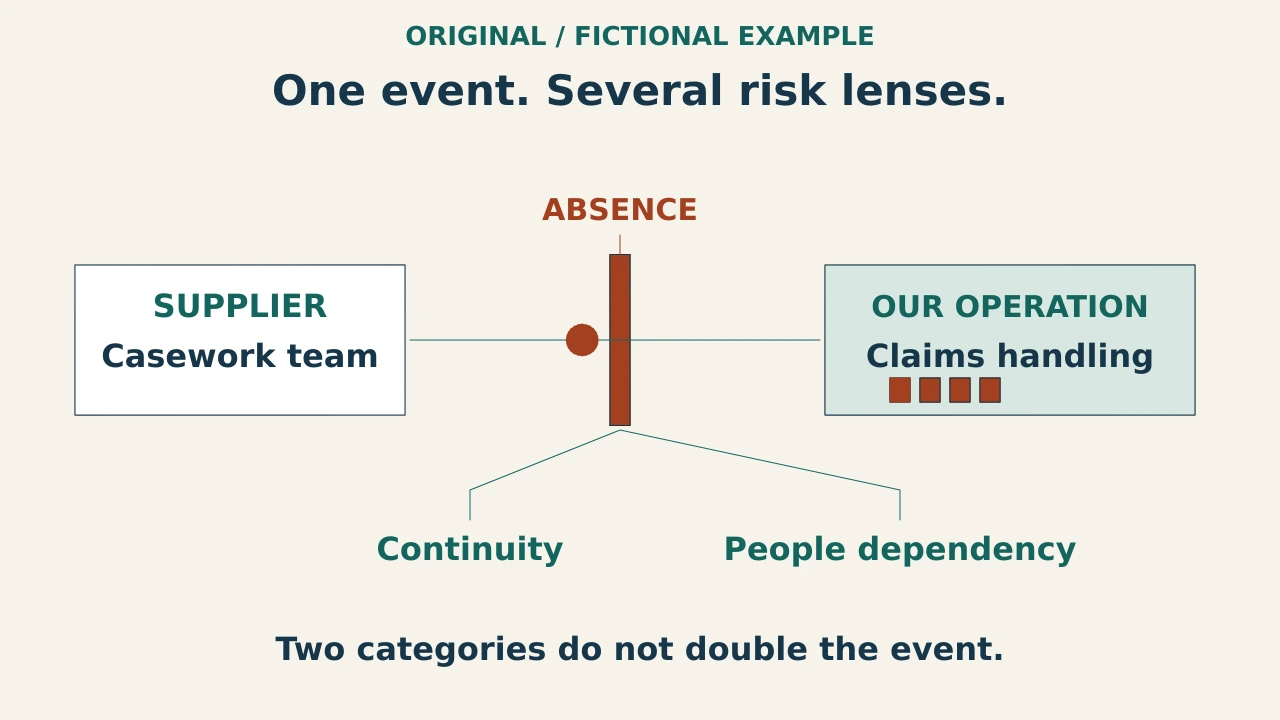
These lenses overlap deliberately. A hosting outage may raise continuity and concentration questions. Record the shared cause rather than counting it as two independent events. The shared-cloud dependency guide works through that problem in more detail.
What are 5 risks?
Five useful risks are five specific scenarios affecting objectives, rather than five adjectives such as low or high. Choose them from the services you actually depend on. Do not assume that a short illustrative list covers a provider’s complete exposure.
What are 5 examples of risk?
All five examples below are fictional. They illustrate questions to investigate, not findings about real suppliers or recommended ratings.
| Scenario | Effect on the organisation | Evidence question |
|---|---|---|
| An insurer’s claims provider loses the only team able to handle exceptions | Urgent cases accumulate even though routine processing continues | Can the fallback team demonstrate an exception case without that team? |
| A fund administrator exports incomplete member-change records | The fund cannot reconcile the changes needed for a handover | Does a controlled sample reconcile with the source and its change history? |
| A service provider cannot sustain a necessary support function | The organisation faces an unplanned transition | What current financial and operational evidence supports continued delivery? |
| A false supplier bank-change instruction passes an email-only check | A payment is sent to the wrong destination | Was the instruction verified through a trusted, independently established route? |
| Two apparently separate suppliers depend on the same hosting region | A single disruption affects both the main service and its supposed alternative | What evidence establishes genuinely separate recovery dependencies? |
Use the financial resilience review and bank-detail verification guide for the specialist checks behind those examples. The tenant restore guide helps distinguish a working platform from recoverable information for your own service.
What are the risks in supply chain management?
Supply-chain risk extends beyond the supplier named on the contract. It can involve upstream technology, subcontractors, people, delivery locations and downstream handovers. In financial services, the chain may move information and work rather than physical stock.
For a fictional fund, a member change might pass through a portal provider, an administrator and a record-transfer interface. An upstream outage, an inaccurate transformation or a failed handover can produce different consequences. Trace the particular dependency needed to deliver the task; an endless catalogue of every supplier’s suppliers is less useful.
The Australian Signals Directorate’s procurement and outsourcing guidance addresses cyber supply-chain risks across technology and service lifecycles. Its cyber scope is useful here, but it does not cover every commercial or operational question in the table above.
What are the 7 key types of risk?
“Key” depends on the service and the organisation’s objectives. A payment deadline makes delivery and fraud controls important. Sensitive member information raises security and privacy questions. An irreplaceable specialist or shared platform raises dependency questions.
Use the seven review lenses above to look for omissions, then prioritise evidenced scenarios through your approved assessment method. Do not rank the categories themselves as universally more or less important. The review-prioritisation guide helps choose which work needs attention first.
What are the 9 major risk categories?
A numbered question alone does not identify which nine-category model is intended. Ask for the framework, its definitions and the level of detail. One model might split cyber and privacy; another may group them within operational risk. A financial-risk taxonomy may have a different purpose from a supplier due-diligence checklist.
For example, the current CPS 220 material-risk framework and the superannuation-specific SPS 220 framework use sector and organisational context. Do not turn their lists into a claim that all suppliers must be assessed against the same nine headings.
Keep a short crosswalk: the proposed category, your organisation’s corresponding term, the scenario it covers and anything left out. The Department of Finance’s risk-framework guidance explains tailoring a framework to its entity. It is written for Commonwealth entities, not a new requirement for private insurers or super funds.
Turn the list into one reviewable record
Choose one service and write the objective, scenario, supporting evidence, uncertainty, owner and next decision. A category is useful when it helps another colleague find and challenge that record. It is not proof that a control works or that a provider is safe.
Use the risk decision-record guide to preserve the reasoning. Where your team already uses an approved framework, keep its terminology and link the specialist evidence instead of replacing it with a new numbered list.