Article
Contrata Monitoring: review a signal without accepting the risk
Check a provider signal against your service and evidence, and keep acknowledgement separate from a risk decision.
Contrata editorial team ·

A news item mentions a supplier your organisation uses. It may concern a different service, region or subsidiary. Your team needs to understand that connection before deciding what to do. Clearing a notification does not establish that the service is safe to continue using.
Contrata’s documented Monitoring workflow puts signals in a provider context. Its incident detail separates what happened, expected impact, relationship relevance, relevant risk themes, news coverage and evidence. Those distinctions give a reviewer useful questions to ask. They do not remove the need to verify the underlying information. Explore the Contrata product.
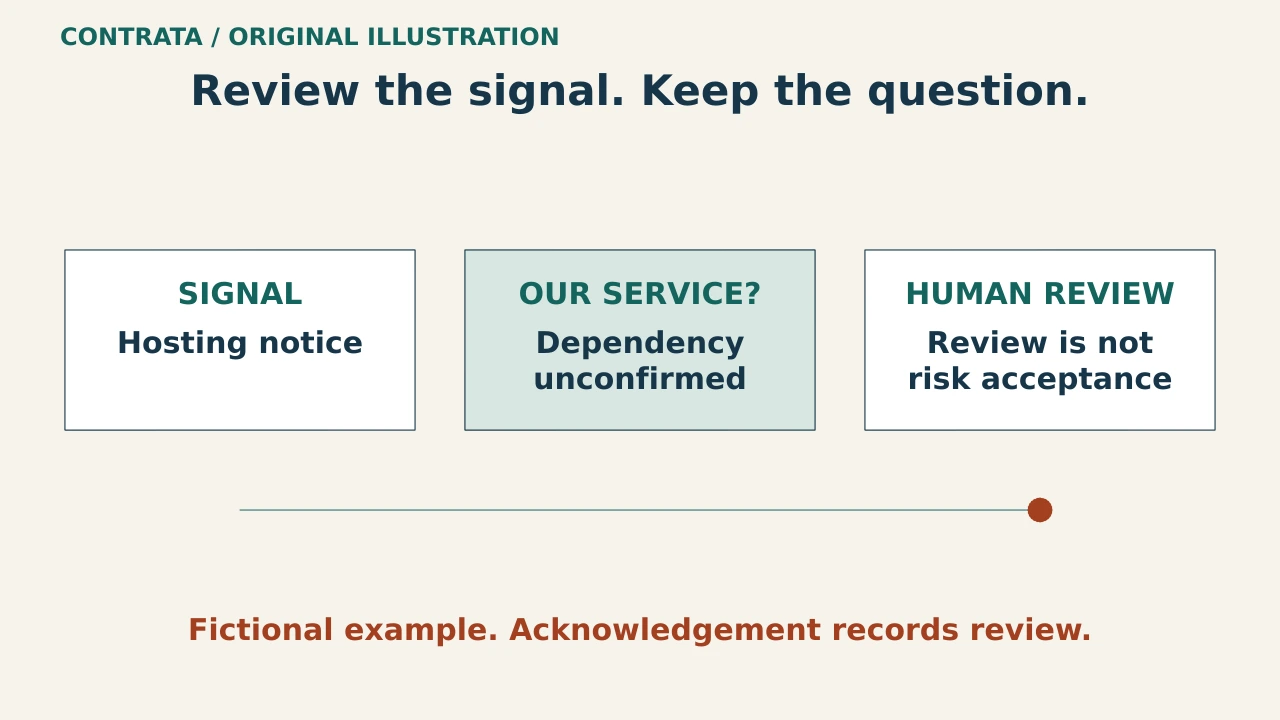
The example below is fictional. Its original diagram and animation explain a review discipline; they are not product screenshots or proof that every suggested step is automated.
Start with the service you use
Imagine that fictional Harbour Services supplies your document exchange service. A signal concerns an interruption at Harbour’s overseas hosting partner. The supplier name matches. You do not yet know whether your document exchange runs on the affected infrastructure.
| Review question | Evidence to seek in this fictional example |
|---|---|
| Is this our provider and service? | Contracted entity, service name and relevant hosting arrangement |
| What does the source actually say? | Original notice, timestamp, stated scope and later corrections |
| How could our operation be affected? | Confirmed dependency and the work that would stop or degrade |
| What remains unknown? | Whether our service uses the affected hosting environment |
| Who decides the response? | Designated service owner and the organisation’s escalation route |
A matched supplier name is a starting point. Ask the service owner or supplier to confirm the dependency. Avoid turning a plausible connection into a confirmed outage while that answer is outstanding.
Challenge the relationship relevance
Compare the account of what happened with the source evidence, then ask whether the expected impact follows for your service. In this example, a public notice names a region but says nothing about the document exchange product.
The working conclusion remains limited: a supplier-related event has been identified; impact on this service is unconfirmed. Keep the notice and the unanswered dependency question available to the colleague who takes the next step.
This does not mean Contrata detects every incident, identifies every subcontractor or confirms exposure automatically. Monitoring sources can be incomplete or change as an event develops. A checked timestamp should prompt the reviewer to consider how current the information is; it is not a guarantee that nothing has changed since.
Acknowledge the review; retain the decision
In the documented product reference, Acknowledge records review, not risk acceptance. A reviewer may have read the signal while a supplier response, operational assessment or authorised decision is still outstanding.
For Harbour Services, a useful handover could say: “Notice reviewed. Dependency on the named hosting environment remains unconfirmed. Service owner to obtain confirmation and assess whether the fallback is needed.” This is suggested record wording, not a claim about an automated field or routing feature.
If later evidence confirms an affected dependency, follow your organisation’s incident and escalation process. If it rules the dependency out, retain the reason for that conclusion. Neither outcome follows solely from a notification’s status.
The supplier-incident intake guide explains the operational handover. Use the third-party risk decision record to separate evidence, judgement and decision authority.
Keep responsibility with the organisation
For APRA-regulated entities, CPS 230 includes ongoing oversight of service providers. A monitoring product can support that work; using it does not prove that the organisation has met the standard. The organisation retains responsibility for risk decisions and applicable obligations. Refer to the current CPS 230 standard and CPG 230 guidance.
In a product demonstration, ask to inspect a signal, the evidence and its relationship context. Check what acknowledgement records, then identify the questions that still need a supplier response or a human decision. That gives the next reviewer a defined task rather than an unexplained cleared notification.